no. two · imperial
Tiananmen Square: 440,000 square metres
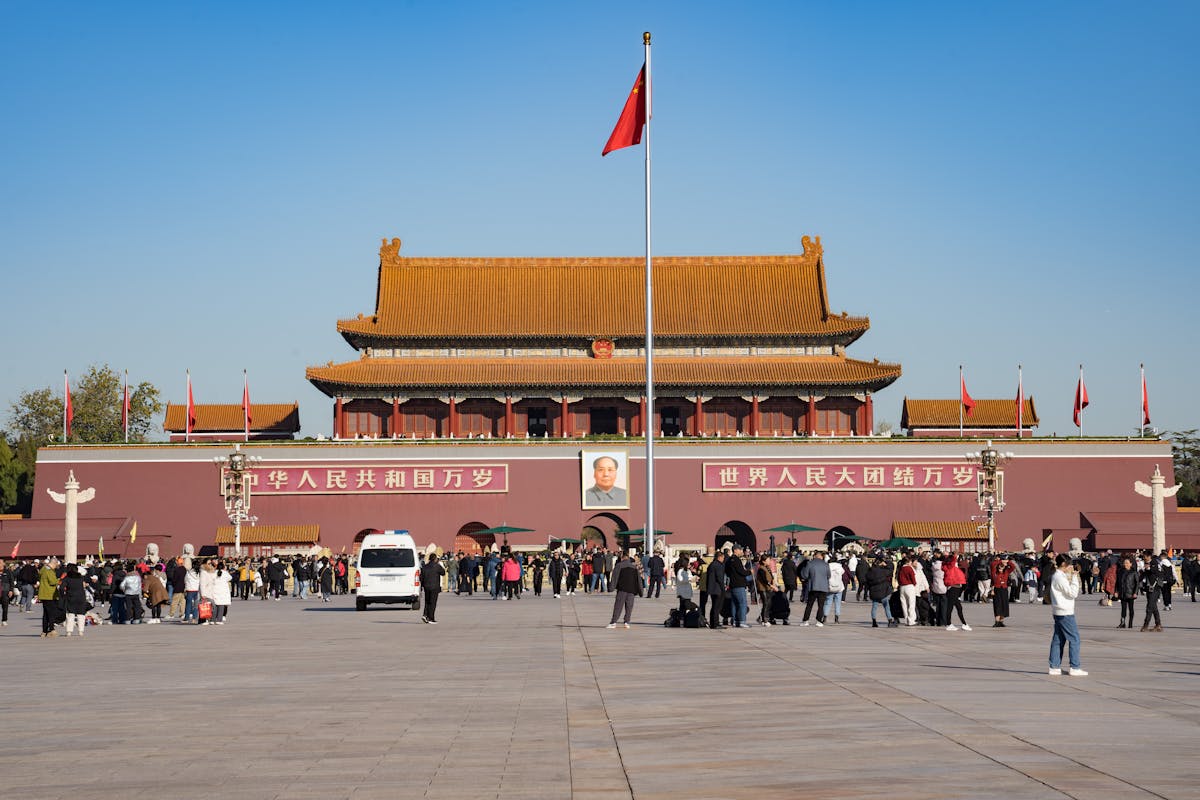
The largest planned public square in the world, 440,000 square metres at the south end of the Forbidden City. Tiananmen Gate (1417) at the north, Mao's Mausoleum (1977) at the south, the Monument to the People's Heroes between them, the Great Hall and the National Museum on the flanks.
- District
- Dongcheng, central Beijing
- Area
- 440,000 m² · approximately 880 m north-to-south, 500 m east-to-west
- Admission
- Square free; Mausoleum free, no bags or cameras inside
- Hours
- Square 24/7 with security check at perimeter; Mausoleum 08:00–12:00 typically, closed Mondays
- Access
- Subway Line 1 to Tiananmen East or Tiananmen West stations
- Document
- Passport required for security check at every perimeter entrance
Set the scale first. At 440,000 square metres, Tiananmen is roughly four times the footprint of St Peter's Square in Rome and more than nine times Red Square in Moscow. Its current dimensions date to 1959, when Mao Zedong's planners cleared a Ming-era market quarter and pushed the boundaries outward to mark the tenth anniversary of the People's Republic. Two of the four monumental buildings that frame it — the Great Hall of the People and what is now the National Museum of China — were finished that same year, in ten months, by an estimated 12,000 workers and 7,000 student volunteers working in shifts.
What stands today is a deliberate axis. Tiananmen Gate seals the north end and connects directly into the Forbidden City beyond. Mao's Memorial Hall closes the south. Between them sits the Monument to the People's Heroes, a 38-metre granite obelisk completed in 1958. Two huge buildings flank the open space east and west. The whole composition reads as a single architectural statement, north–south, oriented on the same imperial meridian that runs through the throne halls of the Qing.
What you're standing in
Roughly 880 metres separate Tiananmen Gate at the north from Qianmen Gate to the south of the square; the square proper, with the Mao Mausoleum closing it, runs about 700 metres on the long axis and 500 metres east-to-west. Walking it slowly takes fifteen minutes; walking it with stops at the obelisk and the gate apron, closer to forty.
One sentence about scale that might not register from photos: the obelisk in the middle is roughly the height of a twelve-storey building.
Underground passages link the main perimeter entrances on the north, east, west and south. These are not always obvious from above ground — security funnelling has shifted entry points more than once since 2008 — and signage in English on the surface points to whichever passages are open on a given day. A counter-clockwise loop from Tiananmen East subway station, through the eastern security gate, around the obelisk and out via the western gate to Tiananmen West, is the standard short visit.
Tiananmen Gate at the north
Tiananmen — the Gate of Heavenly Peace — was first raised in 1417, in the third reign of the Ming Yongle Emperor. It burned and was rebuilt in 1645 under the early Qing, then restored substantially in 1969–70, when the structure was quietly dismantled and reassembled in concrete behind a wooden shell to fix earthquake damage and centuries of decay. The portrait of Mao Zedong above the central archway has hung in some form since 1949, replaced annually before National Day on 1 October.
Visitors can climb the gate. Tickets cost ¥15, sold from a booth on the western side of the gate apron, and access opens at 08:30 and closes at 16:30. From the upper terrace the view runs the full length of the square south to the Mausoleum, with the Monument to the People's Heroes squarely on the central axis. The terrace is also where the Republic was proclaimed on 1 October 1949 — Mao read the founding declaration from a microphone set up at the front balustrade.
Practical note
Bag-check, ID-check and a body scan are required to enter both the gate climb and the square itself. Foreign visitors must carry a physical passport — copies and phone photos are not accepted at the perimeter. Allow 10–20 minutes for security at peak hours, longer in October and during major political events.
Great Hall and National Museum
On the western flank stands the Great Hall of the People, opened October 1959, where the National People's Congress meets every March. Architect Zhang Bo's building is 336 metres long and clad in pale granite from Shandong; the central auditorium seats 10,000. Visits are possible when the Congress is not in session, with tickets at ¥30 sold from the southern entrance — usually weekday mornings, occasionally afternoons, never during sittings.
Across the square on the eastern flank is the National Museum of China, which traces back to two earlier institutions merged in 2003 and reopened in 2011 after a four-year expansion that pushed its floor area past 192,000 square metres — by that measure one of the largest museums in the world. Entry is free; advance online booking is required, with the booking window opening seven days ahead and tending to fill within minutes for weekend slots. Two permanent exhibitions are essential: Ancient China, in the basement, runs chronologically from the Palaeolithic through the Qing; The Road of Rejuvenation, on the north wing, covers Chinese history since 1840.
Mausoleum and Qianmen at the south
Construction of the Chairman Mao Memorial Hall began in November 1976, two months after Mao's death, and was completed in May 1977 — six months from groundbreaking to opening. The building is a low, square pavilion with a peripteral colonnade, set squarely on the central axis between the obelisk and Qianmen, where the southern wall of the inner city once stood. Mao's body lies in a crystal sarcophagus at the centre of the main hall, raised and lowered each day on a hydraulic platform between viewing hours and the cold-storage chamber below.
Admission is free. Hours vary but a typical day runs 08:00–12:00, with the last entry at 11:30; the Hall is closed on Mondays, often closed entirely through January for maintenance, and closed without notice during major political events. Visitors must check all bags, cameras, phones and water bottles at a left-luggage counter on the north side of the hall before joining the queue. The queue itself can run 200 metres at peak; the walk-through past the body takes roughly 90 seconds.
Beyond the Mausoleum, Qianmen Gate (1419) closes the southern view. Qianmen — formally Zhengyangmen — was the principal southern gate of the Ming and Qing inner city wall, the only one of the original gate-and-archery-tower pairs still standing as a complete unit. Its archery tower (jianlou) houses a small museum on the city wall system; the gate itself is climbable, ¥20, the same hours as Tiananmen Gate.
Access, security and the perimeter
Subway Line 1 runs east–west directly under the square, with stations at Tiananmen East (exit A or B onto the eastern perimeter) and Tiananmen West (exit B or C onto the western perimeter). A single fare from Wangfujing or Xidan is ¥3; from further-out stations ¥4–6. Both stations open at 05:10 and close around 23:00. From Qianmen station, one stop south on Line 2, walkable approach runs along the southern axis past the gate of the same name.
Perimeter security is strict.
All entrants pass an X-ray for bags, an ID check, and a body scan. Foreign passports are inspected and sometimes photographed at the gate. Liquids over 100 ml are confiscated; lighters always; tripods often. From October to early November, and around major anniversaries (1 May, 1 July, 1 August, 1 October), the entry process tightens further and parts of the square may close without notice.
Visitors with anything bulkier than a daypack should leave it at the hotel; left-luggage at the perimeter is not always available.
Wheelchair access into the square is possible through the eastern and western gates, both of which have ramped passages from street level. Inside the square, the surface is paved granite, level for most of its length except for the steps onto the obelisk's lower terrace and the apron of Tiananmen Gate. The Mausoleum has a wheelchair-accessible side entrance, signposted at the queue.
Flag-raising and parades
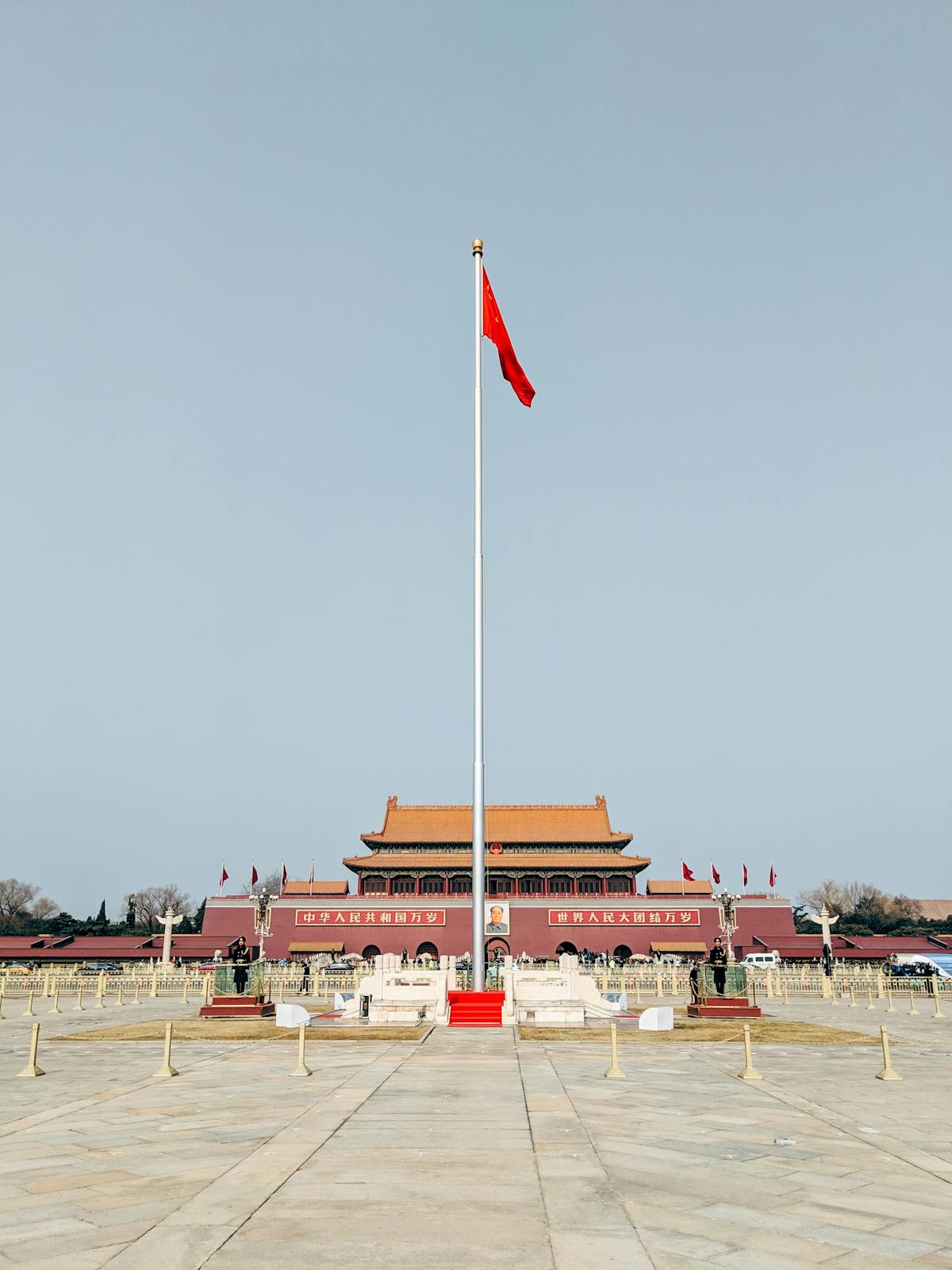
A daily flag-raising ceremony takes place at sunrise at the northern end of the square, conducted by the People's Liberation Army's flag guard. Sunrise in Beijing varies by season — roughly 04:50 in late June, 07:35 in late December — and the official flag-raising time matches it to the minute, posted weekly outside the Tiananmen East subway exit. Crowds gather from 90 minutes before sunrise; the ceremony itself runs 2 minutes 7 seconds. The flag is lowered at sunset by the same unit, with smaller crowds.
National Day on 1 October is the square's other annual peak.
Every tenth anniversary of the founding (so 1959, 1969, 1979… most recently 2019) brings a full military parade down Chang'an Avenue past the Tiananmen reviewing stand, with the rest of the square closed to public access for several days either side. In off-decade years, the day is marked with floral installations across the central axis and crowds heavy enough that timed entry tickets are required for parts of the perimeter.
Onward, the Forbidden City sits immediately north through Tiananmen Gate, with its main entrance at Wumen another 600 metres along the imperial axis. For movement between the square and other parts of the city, see getting around Beijing; for arrival from PEK or PKX, the Beijing airport transfer entry covers the routes in. Further reading on the square's history is collected at Britannica and the city's official tourism portal at visitbeijing.com.cn.