no. eight · the city
798 Art District: Bauhaus factories turned galleries
A 1950s East-German-designed Bauhaus military electronics factory complex in Chaoyang, repurposed as China's largest contemporary art zone since 2002. Some four hundred galleries, studios, design firms, restaurants and bookshops occupy the original sawtooth-roofed brick halls.
- District
- Chaoyang, north-east Beijing · adjacent to Caochangdi
- Original use
- Joint Factory 718 — military electronics, built 1952–1957
- Conversion
- Artists from 2002, drawn by cheap rent and high ceilings
- Admission
- Free entry to the compound; major gallery shows ¥80–150
- Hours
- Most galleries 10:00–18:00, closed Mondays · cafés run later
- Access
- Subway Line 14 to Wangjingnan, 15-minute walk; or Line 15 to Wangjing
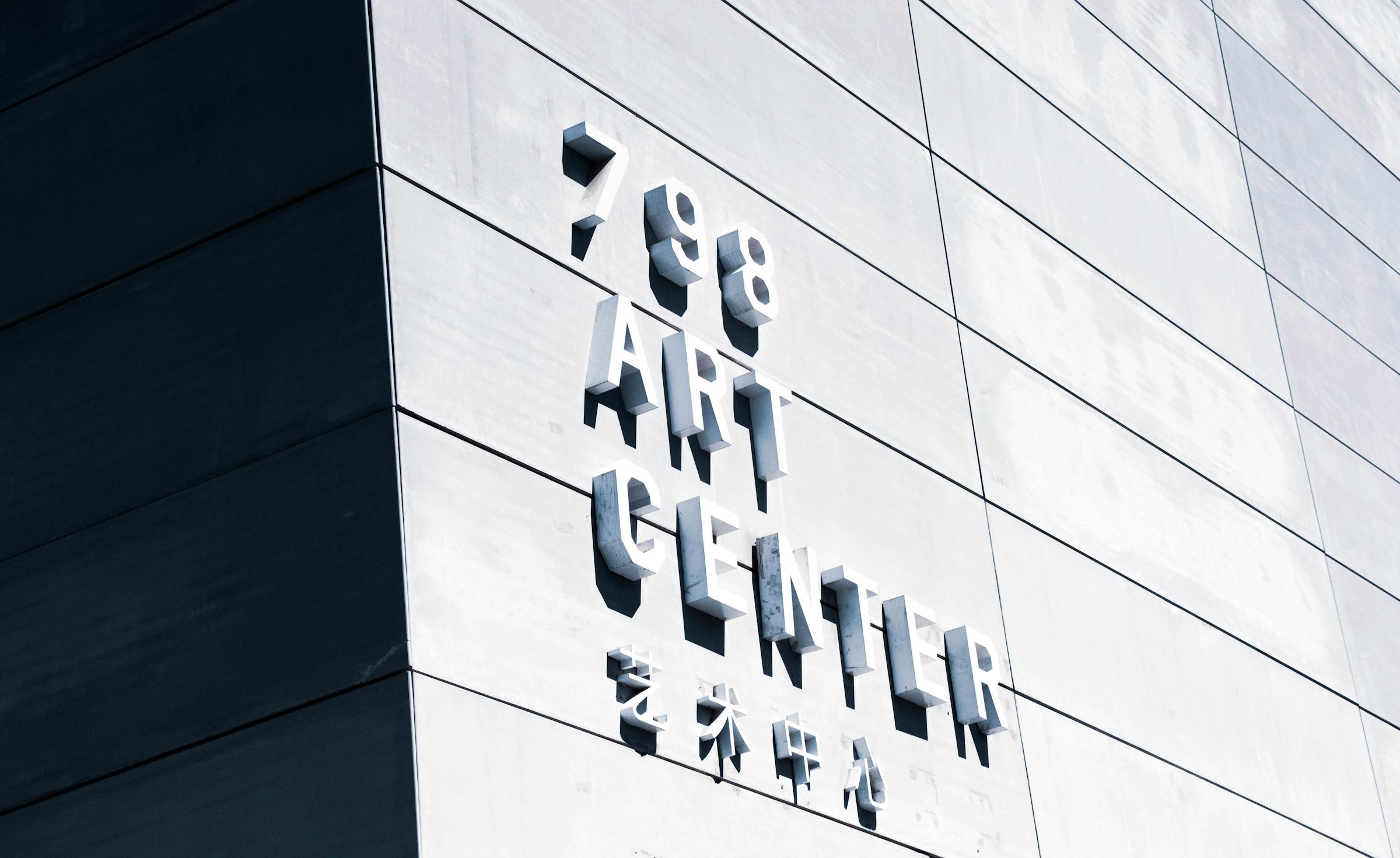
798's main gate sits on Jiuxianqiao Road in north-east Chaoyang, ten kilometres from Tiananmen and a short walk south of the Wangjing business cluster. Behind the gate, brick halls with serrated sawtooth roofs run in long parallel rows — the largest surviving Bauhaus-style industrial complex in Asia, designed by East German architects between 1952 and 1957 for a state military electronics works known as Joint Factory 718. Building 798, one of several numbered halls, gave its name to what the place became after the factory closed.
That second life began around 2002, when artists and designers started taking out leases on the disused workshops. By 2007 the compound had a museum-grade institution at its centre, by 2010 a slate of international gallery branches, and today some four hundred spaces — galleries, studios, design firms, bookshops, cafés — fill the original buildings. The factory's overhead steam pipes, brick brackets, and tall factory glazing remain in place, listed by Chaoyang District as protected industrial heritage.
From Factory 718 to art compound
Joint Factory 718 was conceived in the early 1950s as a centrepiece of Sino–East German industrial cooperation. East German architects led the design while Chinese engineers executed it on the ground; construction ran from 1952 through 1957. The complex made military electronics — components, vacuum tubes, communications equipment — through the Mao era and into the early reform period.
By the mid-1990s, defence-electronics production had largely moved elsewhere and most of the 718 complex stood empty. Rents were low, ceilings were high, and the long unobstructed halls suited what artists and gallerists wanted: room to install large work and to receive visitors. From around 2002 onward, painters, sculptors and photographers began taking spaces — first individually, then through gallery operators willing to lease whole halls.
Robert Bernell's Timezone 8 bookshop, Long March Space, and a handful of artist studios formed the early anchor in 2002–2003. By 2007, when Belgian collector Guy Ullens opened the Ullens Center for Contemporary Art (UCCA) in a former factory hall, 798 had crossed from informal art zone to recognised destination. Pace Gallery's Beijing branch followed in 2008. Tang Contemporary, which already had spaces in Bangkok and Hong Kong, expanded into 798 in the same window.
The Bauhaus architecture
798 is the largest surviving Bauhaus-style industrial complex in Asia. Long single-storey halls, brick-and-concrete construction, sawtooth roofs glazed on the north-facing slope to bring in even daylight without direct sun — the archetype of a 1920s German factory, transposed to Chaoyang in the 1950s.
Specific original features remain visible across the compound: overhead steam pipes that once carried heat from a central plant, painted Maoist slogans in red on interior walls (deliberately preserved by some galleries), bevelled brick brackets at the eaves, and the original factory glazing in its black-painted iron frames. The sawtooth roofs are the most recognisable signature — visible from any of the main lanes, and reproduced in countless gallery photographs and design-firm logos in the compound.
Heritage status
Buildings within 798 are listed by Chaoyang District as protected industrial heritage. The listing means original facades and structural features cannot be removed in renovations, though interior fit-outs by individual galleries are permitted. The result is uniformity outside, sharp variation inside — gallery to gallery.
The major galleries
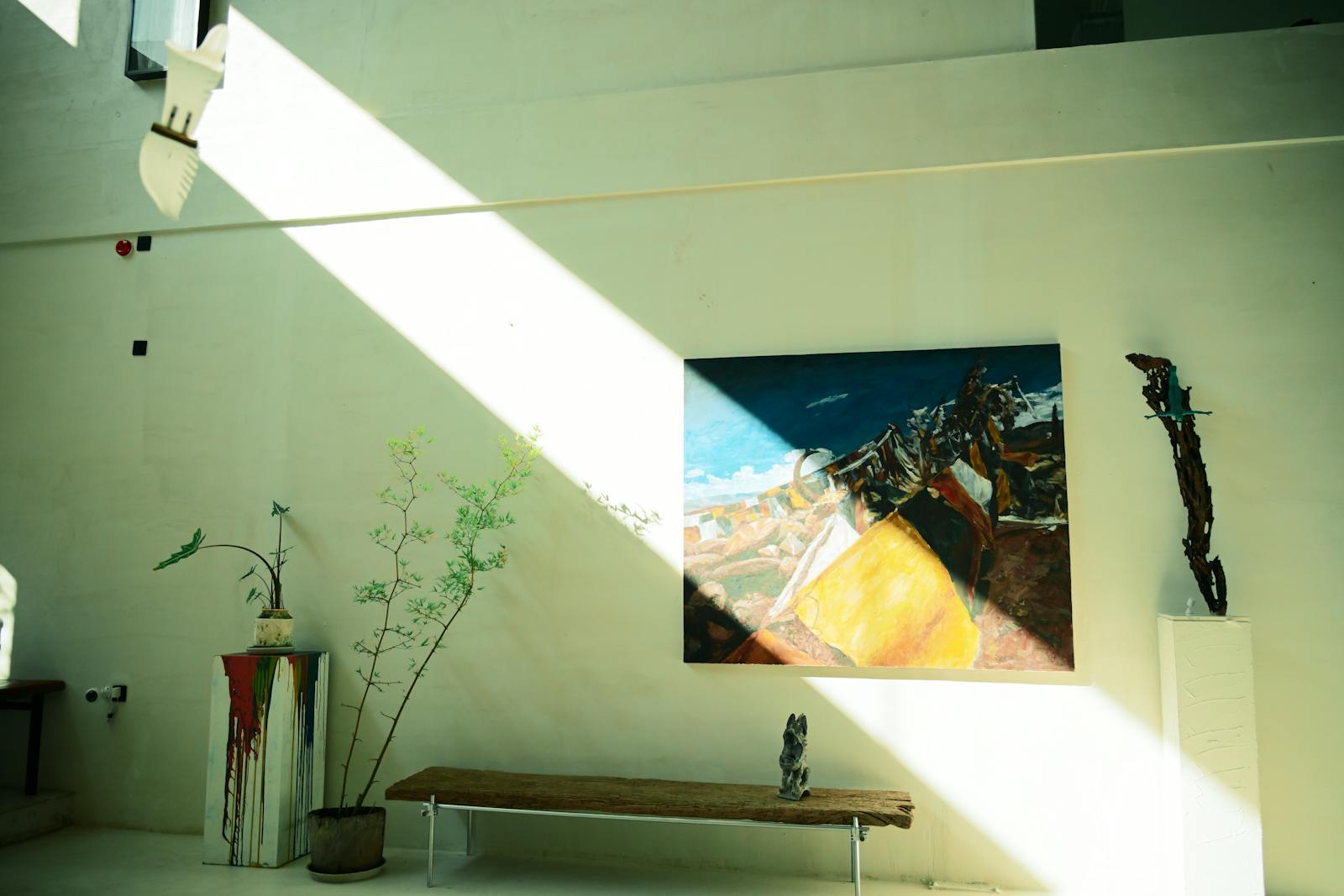
Roughly four hundred spaces operate inside 798 at any time, of which thirty to fifty are full commercial galleries; the rest are studios, design firms, restaurants, retail and bookshops. Four institutions anchor the gallery side.
- UCCA — Ullens Center for Contemporary Art. Founded 2007 by Guy Ullens, now operating as a non-profit foundation under Chinese leadership. Museum-grade exhibitions running two to four months. Major shows ¥80–150 (occasional free-entry days), open 10:00–19:00 daily. The largest single venue in the compound. ucca.org.cn
- Pace Beijing. Branch of Pace Gallery (New York/London/Geneva/Hong Kong/Seoul), opened 2008 in a converted boiler house. Programme leans toward established international names with Chinese-market resonance. Free entry. pacegallery.com
- Tang Contemporary Art. Multi-city operation with spaces in Beijing, Hong Kong and Bangkok. Programme mixes Southeast Asian and Chinese artists. Free entry.
- Long March Space. One of 798's earliest gallery anchors, founded 2002 around the Long March Project — a curatorial initiative tracing the route of the historical Long March. Free entry, more conceptual programme.
Beyond the four anchors, smaller commercial galleries change names and addresses regularly; the Beijing gallery scene shifts with leases. Britannica traces the wider arc of contemporary Chinese art from the 1979 Stars Group exhibition through the post-1989 cynical realists into the 798-era institutional turn — useful background for visitors unfamiliar with the lineage.
Within China's art ecology — and against M50
798 occupies a particular position in China's contemporary art geography. It is bigger, more institutional and more international than its closest counterpart, Shanghai's M50 on Moganshan Road. M50 — converted textile mills along Suzhou Creek — runs to roughly a hundred and fifty spaces, weighted toward emerging artists and smaller commercial galleries; 798 runs to four hundred, weighted toward established names and museum-grade shows.
Both compounds emerged in the same period (2002 for 798, 2000 for M50) and from similar conditions: state-owned industrial sites, falling rents, artists looking for space. They diverged through scale and tenancy. 798 attracted UCCA, Pace and Tang; M50 stayed closer to its origins as an artists' enclave. Visitors with limited time in China who can see only one tend to find 798 more rewarding for institutional work, M50 more rewarding for studio visits.
798 also sits adjacent to Caochangdi, a smaller and considerably less polished art zone two kilometres east — site of Galerie Urs Meile, several artist-run spaces, and Ai Weiwei's former studio. Visitors with a half-day can do both compounds; Caochangdi rewards the walker more than the gallery-hopper, and many of its spaces operate by appointment.
Access, hours, ticketing
Subway is the simplest approach. Line 14 (north loop) stops at Wangjingnan, from which the main 798 gate is a fifteen-minute walk south-east along Jiuxianqiao Road. Line 15 stops at Wangjing, slightly further. Taxis from central Beijing run ¥50–80 in normal traffic; the journey takes 25–40 minutes from Tiananmen.
Entry to the compound is free. Wandering the lanes, browsing bookshops, sitting in a café — none of it costs anything beyond what visitors choose to spend. Most galleries are also free. The exceptions are large temporary exhibitions at UCCA, where ticketed shows run ¥80–150 depending on programme; tickets are sold at the door and through UCCA's WeChat mini-programme.
Most galleries open 10:00 or 11:00 and close 18:00 or 19:00; closing day is Monday across the majority of spaces. Cafés and restaurants open earlier and close later — many run from 09:00 through 22:00, some independents go past midnight on weekends. Photography inside galleries is generally permitted unless individual exhibitions specify otherwise; flash and tripods are widely restricted.
| Space | Entry | Hours | Closed |
|---|---|---|---|
| Compound (lanes, shops, cafés) | Free | All day | — |
| UCCA — major exhibition | ¥80–150 | 10:00–19:00 | Mondays |
| Pace Beijing | Free | 10:00–18:00 | Mondays |
| Tang Contemporary Art | Free | 11:00–18:00 | Mondays |
| Long March Space | Free | 11:00–18:00 | Mondays |
| Smaller galleries | Free or ¥20–60 | Variable | Mostly Mondays |
Eating and drinking on the compound
798 is an unusual destination in central Beijing for the breadth of its on-site food: instant-coffee chains and standalone independents share the same lanes. Several of the older cafés date back to the early-2000s artist period, and run as much as social hubs as commercial cafés.
Bookshops sell catalogues, design press and translated theory. Timezone 8 — one of the original 2002 anchors — closed in 2010 but its successor, Page One's 798 outpost, carries a similar editorial mix. Most cafés take Alipay and WeChat Pay; cash is increasingly rare, and foreign cards work in only a handful of spaces.
When to come
Saturday afternoon is the compound at full activity — every gallery open, openings often running, restaurants busy, the lanes crowded with photographers and design students. Weekday mornings are the opposite: quieter, gallery owners or curators frequently on site, and the architecture more visible without crowds. Sunday afternoons sit between the two.
Mondays are best avoided. The compound itself remains open and a handful of cafés operate, but most galleries close, which means UCCA, Pace, Tang and Long March all dark on the same day. Visitors with one day in Beijing should not spend it at 798 on a Monday.
798 is what happens when an industrial complex outlasts its industry by half a century, and the buildings are too good to demolish.
For visitors planning a wider lived-city day, 798 pairs well with the Nanluoguxiang hutongs in the morning and the compound in the afternoon — the contrast between Qing-era courtyard residential fabric and 1950s socialist-modern industrial fabric is sharper when set against each other in a single day. Visitors more focused on imperial history should treat 798 as a half-day add-on after the Forbidden City; for arrival logistics into Beijing as a whole, see getting around Beijing. Further planning notes for the city, including subway maps and station passes, are at visitbeijing.com.cn.