no. seven · the city
Hutongs around Nanluoguxiang: courtyards and alleys
The grid of narrow alleys north of the Forbidden City, lined with siheyuan courtyard houses dating from the Yuan dynasty onwards. Nanluoguxiang and the surrounding lanes — Mao'er, Yandai Xiejie, Wudaoying — survive as a living residential quarter, increasingly tourist-influenced.
- District
- Dongcheng, north of the Forbidden City
- Origin
- Yuan dynasty grid, 13th c.; many siheyuan early Qing
- Admission
- Free; private courtyards and hotels have own pricing
- Hours
- 24/7 — residential
- Access
- Subway Line 6 or Line 8 to Nanluoguxiang station
Nanluoguxiang runs 786 metres north to south, laid out in 1267 as part of Kublai Khan's Dadu — the Yuan-dynasty capital that preceded Beijing. Its name translates roughly as "South Gong-and-Drum Alley", a reference to the Drum and Bell Towers that anchor the northern end. Eight lanes branch east and west off the central spine in a tight comb pattern that has survived seven centuries of dynastic change, demolition cycles and, most recently, commercial redevelopment.
What sits here today is a single working residential quarter, not a museum. People live in these courtyards. Vegetables are sold from carts in the morning, schoolchildren walk to class along the same paving stones tourists photograph by afternoon, and old men play xiangqi on folding tables in the shade. Some lanes have been almost entirely converted to cafés and design shops; others remain largely untouched, with peeling paint, parked bicycles and the smell of coal smoke in winter.
What a hutong is
The word hutong derives from Mongolian hottog, meaning well or water source — a residue of the Yuan dynasty's Mongol ruling class, who imposed a regular grid on the older, more organic Han city plan when they founded Dadu in 1267. Each cluster of households would have shared a well, and the alley running between two such clusters took its name from that water source.
An alley qualifies as a hutong by width: traditionally between roughly 3 and 9 metres, narrower than a proper street but wide enough for two people to pass with bicycles. Beijing once had around 3,000 of them. By the 1980s the figure was about 1,300. Estimates today put the number under 500, with the survivors concentrated in three pockets — the Nanluoguxiang grid, the area around the Drum and Bell Towers, and a thinner band south of Tiananmen.
Nanluoguxiang and the eight lanes
Nanluoguxiang itself is now a pedestrianised commercial street: bubble tea, calligraphy stalls, design shops, a small cinema, several courtyard cafés. Walking it end to end takes ten minutes without stopping, an hour with. The interesting part is what branches off it.
Four lanes run east, four run west. Together they are sometimes called the Eight Lanes, though the names rotate depending on which historian is counting. The eastern lanes tend to be more residential; the western lanes carry more of the surviving courtyard hotels and design studios.
- Mao'er Hutong — runs west off Nanluoguxiang. Number 35–37 was the family residence of Wan Rong, the last Empress of China, who married Puyi in 1922. The compound is not generally open to visitors but the gateway and outer wall can be seen from the lane.
- Ju'er Hutong — also west. A mix of Yuan-era housing fragments and later restorations; one of the courtyards here was rebuilt in the 1990s as a model siheyuan and won an Aga Khan Award for Architecture in 1992.
- Yandai Xiejie — "Smoking Pipe Slant Street", a diagonal lane running north-west toward the Houhai lakes. Once home to tobacco-pipe makers; now a 230-metre commercial strip of bars and souvenir shops.
- Mengduan Hutong — historically the quarter for imperial Mongolian translators. Quieter than its neighbours and largely residential.
- Hou'gulou Yuan Hutong — Drum Tower South Lane, leading toward Gulou.
Two further lanes worth naming are not technically among the eight but lie within the same grid: Wudaoying Hutong, four blocks east, has become the densest concentration of cafés, vegetarian restaurants and design retailers in the area; and Beiluoguxiang, the northward continuation of the central spine, is quieter, less commercial, and easier to walk.
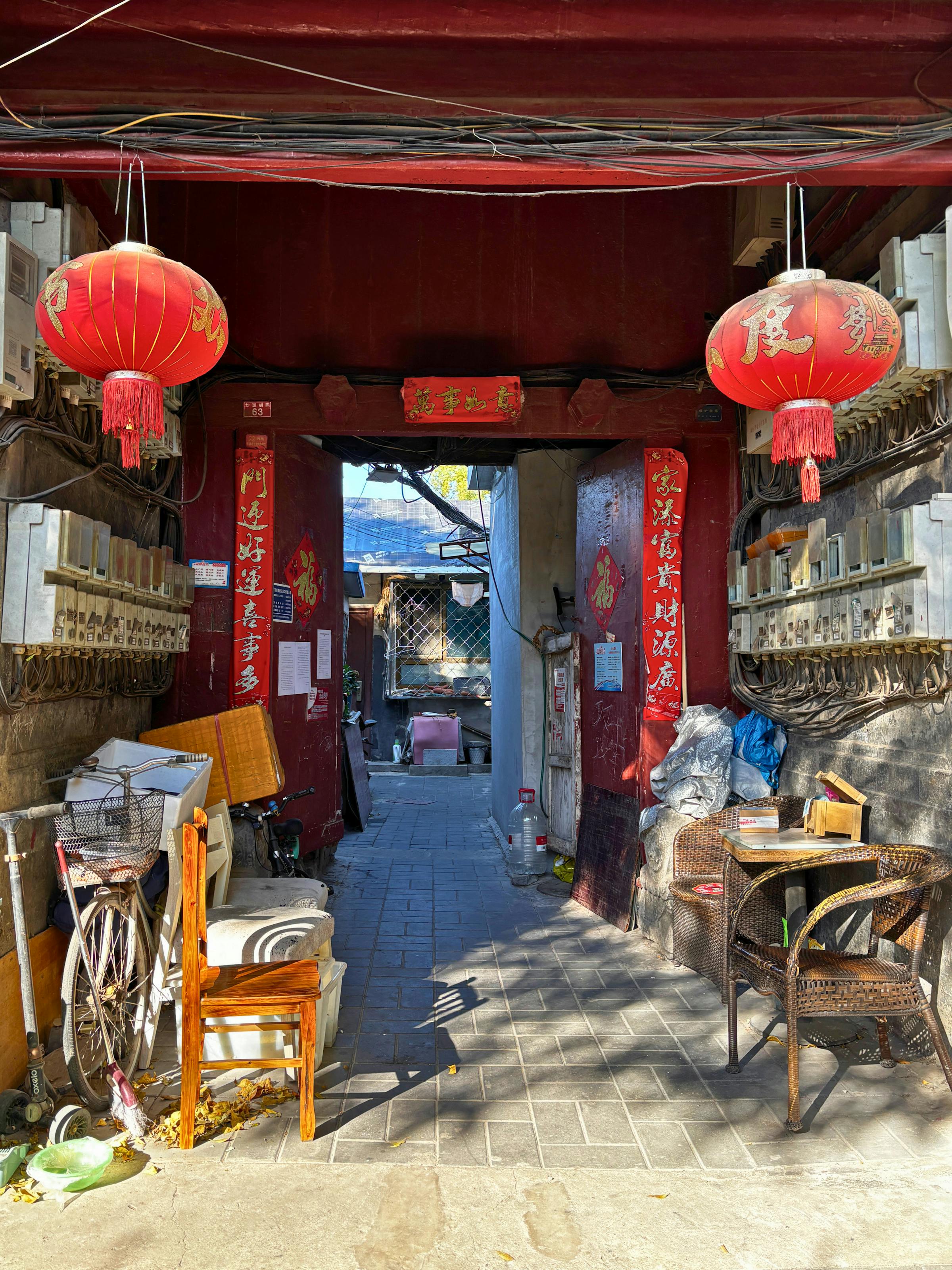
The siheyuan courtyard house
The building type behind every wall in this grid is the siheyuan — literally "four-sided courtyard" — a quadrangle of single-storey buildings arranged around a central open space. The form was standardised under the Yuan and refined under the Ming and early Qing, and it follows a strict hierarchy.
The northern building, facing south, is the principal hall — best light, warmest in winter, traditionally occupied by the head of the household. Eastern and western wings house adult sons and their families, ranked east over west. The southern building, opposite the principal hall, is for service rooms — kitchen, storage, sometimes servants. A spirit screen wall just inside the main gate blocks direct sightlines into the courtyard, both for privacy and, in older belief, to deflect malevolent spirits travelling in straight lines.
A note on scale
A single-family siheyuan from the Qing period would typically occupy 300–500 square metres of ground area, housing one extended family of perhaps a dozen people. Most surviving courtyards have been subdivided since the 1950s into dazayuan — "big mixed yards" — where five to fifteen unrelated families share the same quadrangle, with shacks and lean-tos filling what was once open space.
Restoration economics now run in the opposite direction. A handful of courtyards in this grid have been bought back, cleared of accretions, and converted into boutique hotels, design studios or single-family residences for wealthy returnees. Rooms in the better-known courtyard hotels — Orchid Hotel on Baochao Hutong, the Graceland Yard on Wudaoying — run ¥800–2,500 per night.
Drum and Bell Towers at the north end
Standing at the north end of the Nanluoguxiang grid, on a small public square, are two of the city's older surviving structures. Gulou (Drum Tower) and Zhonglou (Bell Tower) stand 100 metres apart on the same north-south axis, the bell behind, the drum in front.
Both date in their current form from the Ming reconstruction of 1420 and Qing rebuilds (1745 for Zhonglou after a fire). Their original Yuan-era function was timekeeping for the imperial city: the drum struck the night watches, the bell answered at dawn. A demonstration drumming is still performed several times daily on the upper level of Gulou (every half-hour, 09:30–17:00).
Climbing both towers requires separate tickets, ¥20 each, with steep wooden stairs in each case — sixty-nine steps up the Drum Tower, seventy-five up the Bell Tower. Views from the upper galleries take in the grid of grey-tiled siheyuan roofs running south toward the Forbidden City. Both close at 17:00 in winter, 17:30 in summer.
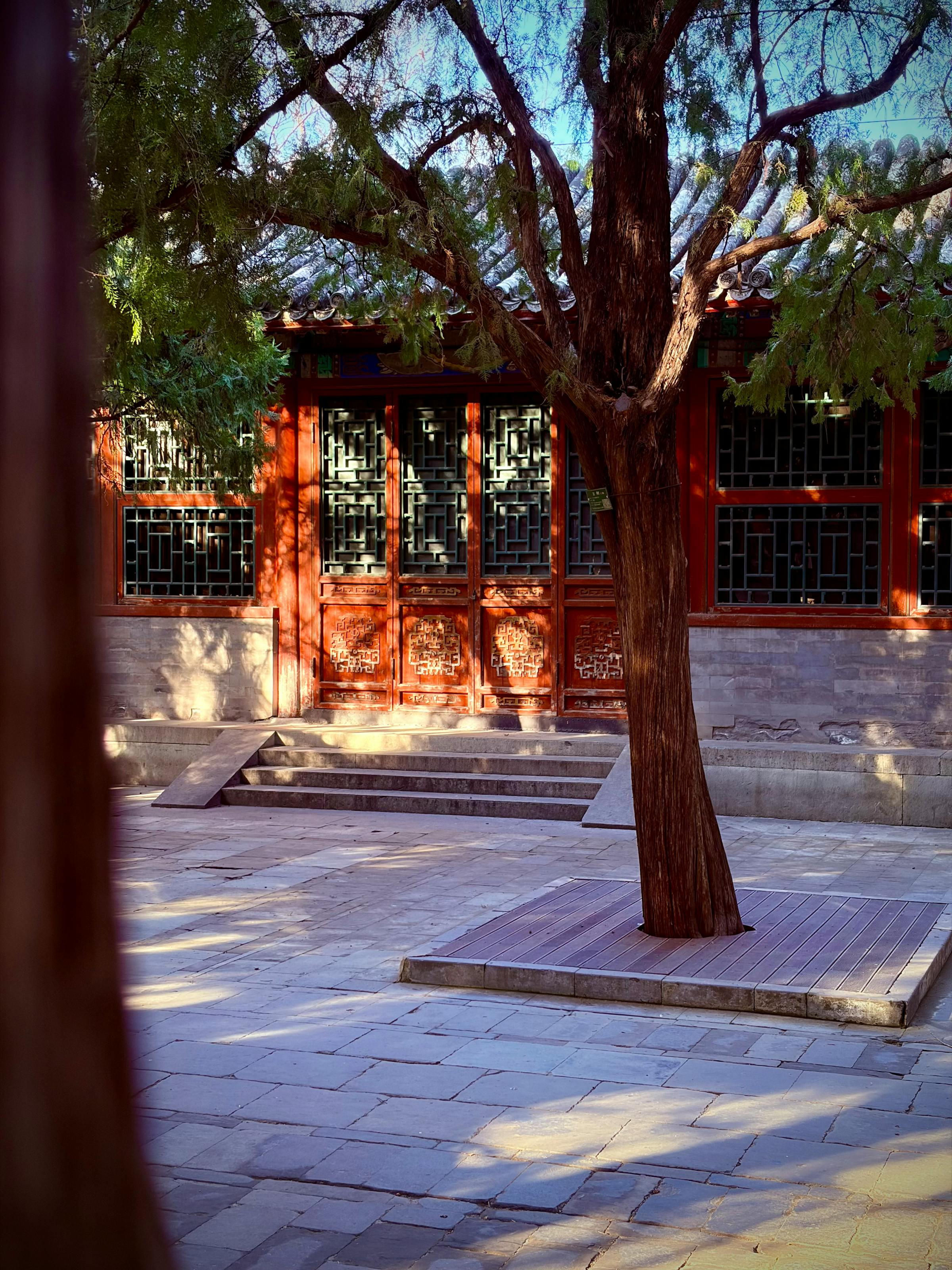
Quieter alleys, where to walk
Visitors who arrive at Nanluoguxiang station and walk only the central spine will see the most commercialised version of the quarter. Stepping one lane east or west reveals a different scale of activity.
For the quietest walking, try the eastern lanes between Nanluoguxiang and Jiaodaokou Nan Dajie — Banchang Hutong, Heizhima Hutong, Dongmianhua Hutong. These remain largely residential, with low foot traffic, working courtyard gates and the occasional laotang public bathhouse still in operation. Photography is fine in the lanes; photography through open courtyard gateways into private homes is not.
An efficient half-day route runs: enter at Nanluoguxiang subway station (south end), walk north along the spine, branch west into Mao'er Hutong, double back, continue north to the Drum Tower square, climb Gulou, walk west along Yandai Xiejie down to Houhai's southern shore. Total walking distance is around 3 kilometres, with three or four climb-able stops.
When to come
Time of day changes the place more than season does. Before 09:00 the lanes belong to residents — produce vendors, schoolchildren, men carrying bird cages to the park. After 11:00 they fill with tour groups, peaking around 14:00–16:00, when the central spine becomes uncomfortable for walking pace. From around 18:00 the tour groups thin out and the cafés and bars take over; the lanes have a different, lit-window quality between dusk and 22:00.
Winter (December through February) is cold but visually striking — bare trees frame the rooflines and coal smoke catches the low light. Summer afternoons can run above 35°C with high humidity and are best avoided between noon and 16:00. Spring and autumn are the comfortable seasons; during the first week of October the area is unusable from crowd density alone, as it falls inside the National Day holiday.
Tours, etiquette, practicalities
Rickshaw tours are heavily marketed at the south end of Nanluoguxiang and around the Drum Tower square. Standard rates are ¥150–250 per rickshaw for a one-hour loop, typically with two passengers per vehicle and a driver-narrator who speaks variable English. The tours are commercial rather than educational; walking the same routes on foot covers more, costs nothing, and avoids the rapid pace at which rickshaws cycle past the most interesting frontages.
The hutongs are not a sight one views; they are a place one walks through, slowly, on the way to somewhere else.
A few practical notes. Public toilets are signed in English at intervals along the main lanes; courtyard hotels will usually allow non-guests to use facilities if asked politely. Cash is rarely needed — most cafés, shops and rickshaw drivers accept Alipay or WeChat Pay. For onward exploration, the Lama Temple sits a short walk east, and the Houhai lakes begin just west of Yandai Xiejie. Visit Beijing publishes occasional updated walking maps; for background on the siheyuan as a building type, see Britannica's entry; broader UNESCO-tracked context on Beijing's historic city is available via UNESCO World Heritage.