no. eleven · practical
Beijing airport transfer: PEK and PKX to the city
Any Beijing airport transfer starts with two international airports, separated by some seventy-five kilometres. The trade-offs between them — and within each — are sharper than at most major cities, and which airport a visitor lands at changes the whole arrival.
- Capital Airport
- PEK · 32 km north-east of central Beijing · opened 1958, Terminal 3 added 2008
- Daxing Airport
- PKX · 46 km south · opened September 2019 (architect Zaha Hadid)
- Fastest from PEK
- Airport Express + Subway: ~35–40 min to centre
- Fastest from PKX
- Daxing Express to Caoqiao + Subway transfer: ~30–35 min
- Cheapest
- Subway combo: ¥25 (PEK) or ¥35 (PKX) plus a transfer fare
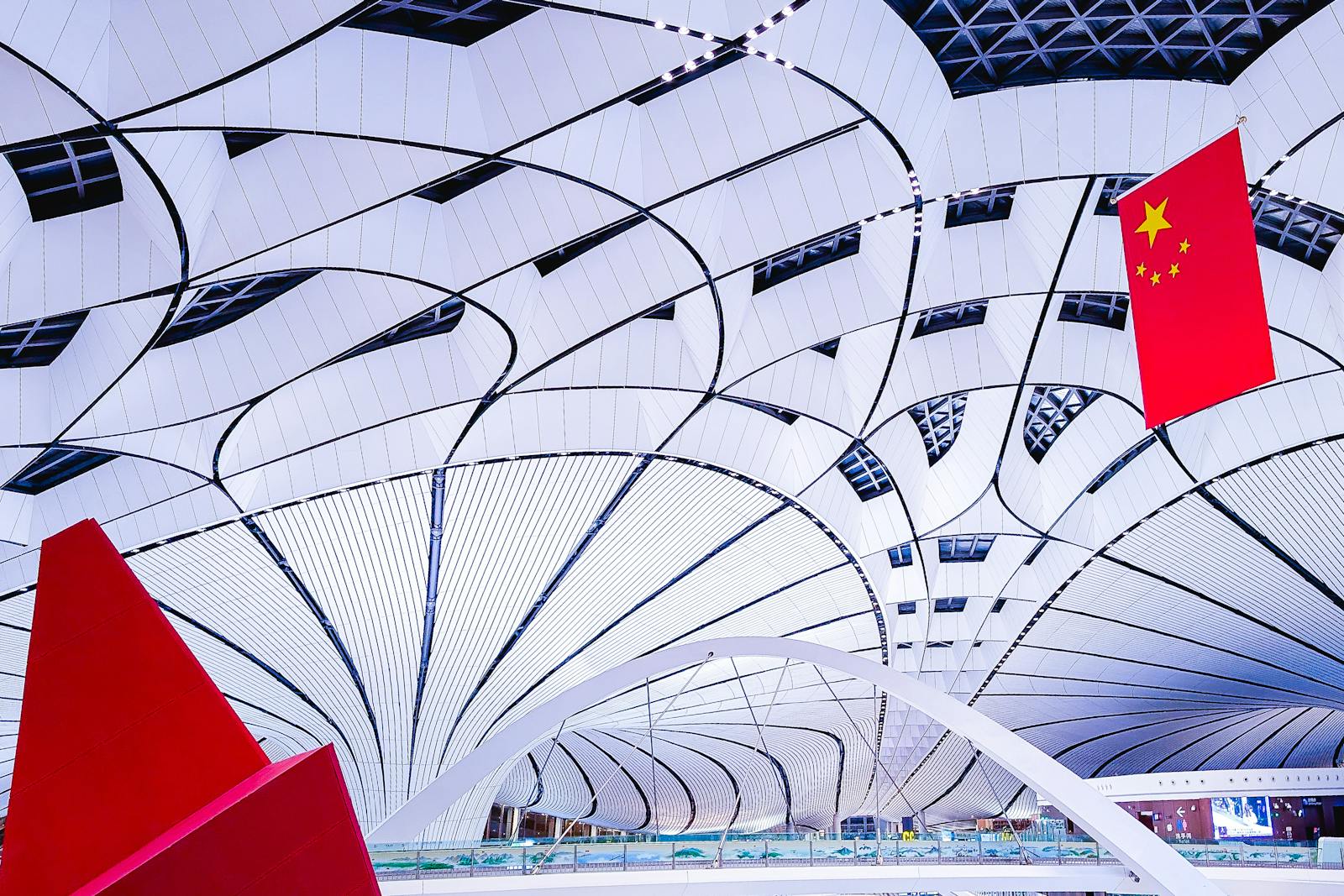
Beijing's two international airports occupy opposite corners of the city's outskirts. Capital International (PEK) sits 32 kilometres north-east of the Forbidden City, served the city alone from 1958 through 2019, and remains the larger of the two by passenger volume. Daxing International (PKX) sits 46 kilometres to the south, opened in late 2019 inside a Zaha Hadid-designed terminal that resembles a six-armed starfish from above, and now handles a growing share of the country's domestic and international long-haul traffic.
This entry covers both airports. The first half is how to choose between options for a Beijing airport transfer when you don't yet know which airport your flight uses; the second half is the specifics of each once you do. Distance and route differ between the two; timing and cost differ even more.
The geography of two airports
PEK is closer to the centre but on the wrong side for many destinations south of Tiananmen. PKX is further but its Daxing Express subway runs straight into the southern subway grid at Caoqiao, where Line 10 connects to most of the rest of the city. Distance is not destiny here — for a hotel near Beijing South Railway Station, PKX may actually be faster than PEK despite being fourteen kilometres further out.
Two airports, two subway expresses, two sets of taxis, two surcharges. The choice between options inside each airport matters more than the choice between airports — most travellers don't pick the airport, the airline does.
From PEK (Capital Airport)
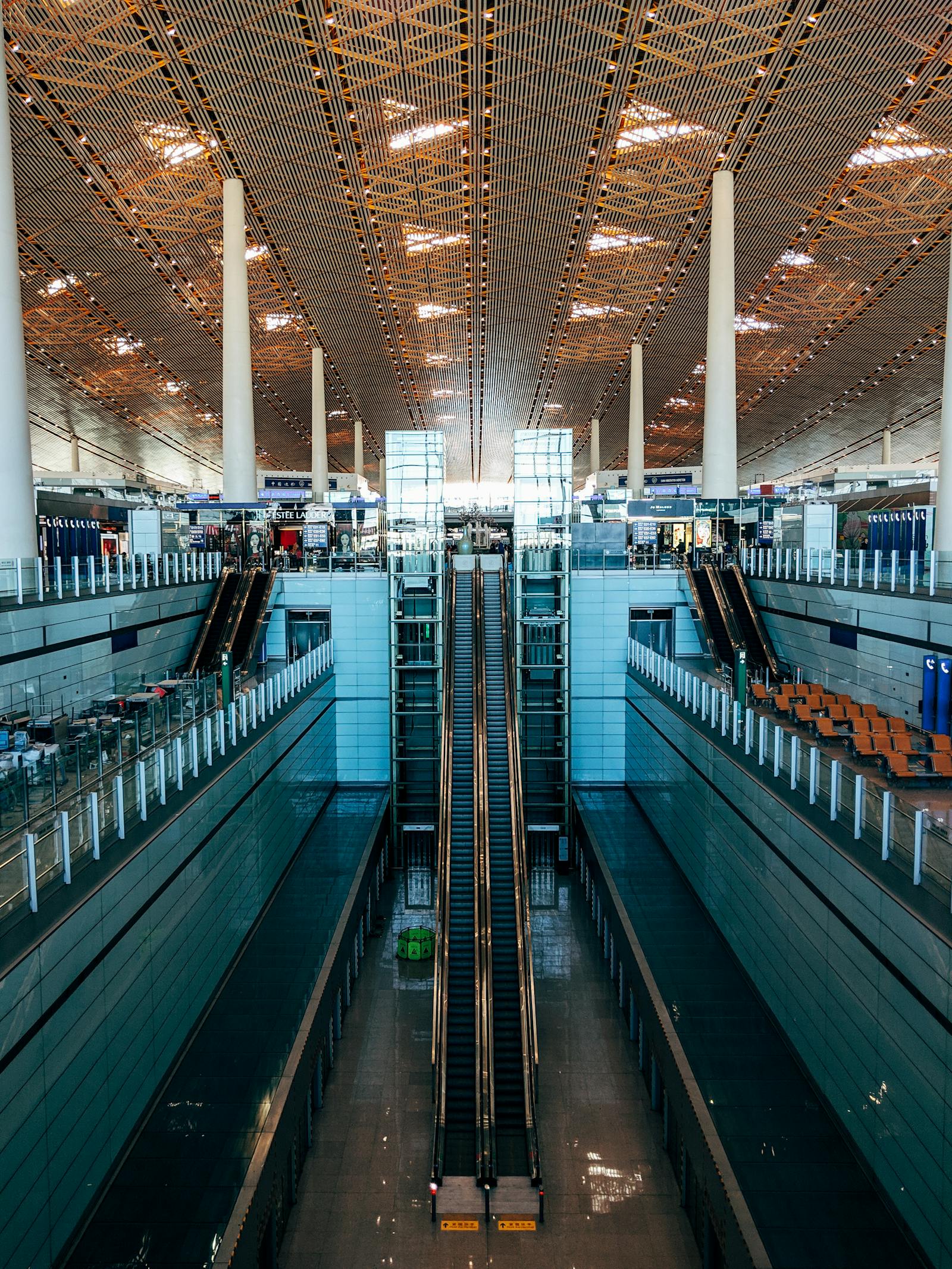
PEK is the older and larger airport, with three terminals, the busiest of which is Terminal 3 — the curved 2008 Norman Foster building that handles most international flights. Subway, taxi, shuttle bus and pre-booked transfer all run from PEK into the city.
Airport Express subway
The Capital Airport Express is a dedicated subway line connecting PEK Terminals 2 and 3 to Dongzhimen station, where Lines 2 and 13 of the regular subway pick up. Trains run every 8–12 minutes from 06:21 to 22:51 (last train from PEK), the journey is 20–25 minutes, and the fare is a flat ¥25. From Dongzhimen to most central destinations is another 15–20 minutes on the regular subway at ¥3–7.
Total time from PEK arrivals to People's Square or Tiananmen: about 50 minutes door to platform. Total cost: ¥28–32. The Express runs above ground for most of its route, which is a useful arrival into the city after a long-haul flight.
Capital Airport Bus shuttles
The Capital Airport Bus operates roughly fifteen numbered shuttle routes from PEK into and across central Beijing — Line 2 to Xidan, Line 3 to Beijing Railway Station, Line 5 to Zhongguancun, Line 7 to Beijing West Station, plus several inter-city routes. Fares run ¥25–30, journey times 60–90 minutes depending on traffic. Tickets sold from a counter inside arrivals; cash and Alipay accepted.
Licensed taxi
Taxi rank outside arrivals at all three terminals, with dispatchers in fluorescent vests during peak hours. Beijing taxi base fare is ¥13 for the first 3 km, ¥2.30 per km thereafter, plus a ¥1 fuel surcharge and the ¥10 expressway toll added at the end. Total fare from PEK to central Beijing typically lands at ¥80–150 in normal conditions, ¥150–200 during the 17:00–20:00 commute window.
Pre-booked private transfer
For travellers arriving on long-haul flights, especially after dark or with families, a pre-booked private transfer often beats both the subway and the metered taxi on overall friction. A driver waits at arrivals with a name placard, the price is fixed before arrival, the vehicle is comfortable, and the operator tracks the flight so the driver waits even if the flight is delayed.
Standard sedan rates for a Beijing Capital airport transfer typically run ¥250–400 to central destinations; minivans for groups of four or more, ¥400–700. The cost differential against a metered taxi is real but the friction reduction at the end of an international flight often justifies it, particularly for first-time visitors.
Practical note
Avoid touts inside the PEK arrivals hall offering "taxi service" at fixed prices; they are unmetered private cars, not licensed taxis, and the price quoted will typically be triple the meter. The licensed rank is on the kerb outside arrivals, signed in English and with a uniformed dispatcher.
From PKX (Daxing Airport)
PKX opened in September 2019 as a relief and replacement for parts of PEK's domestic capacity. It is forty-six kilometres south of central Beijing — further than PEK from the Forbidden City, but closer to the southern part of the city — and the routes into town reflect that southern position.
Daxing Airport Express subway
The Daxing Airport Express, opened with the airport in 2019, runs from PKX Terminal directly to Caoqiao station on Line 10, in 19–30 minutes depending on stopping pattern. From Caoqiao, Line 10 connects to most of the rest of the central subway grid. Fare is ¥35 (one-way) for the express, plus ¥3–7 for the connecting subway.
Trains run every 8–10 minutes from approximately 06:00 to 22:30. Total time from PKX arrivals to Tiananmen East: about 50–55 minutes including the Caoqiao transfer. Total cost: ¥38–42.
Beijing–Xiongan intercity train
An intercity high-speed train links PKX to Beijing West Railway Station in 20–30 minutes, with departures every 10–60 minutes depending on time of day. Fare is ¥35 (second class). Useful primarily for travellers heading to a hotel near Beijing West, or transferring directly to a high-speed train onward (Xi'an, Shanghai, etc.); less useful for central destinations, since Beijing West is itself thirty minutes from Tiananmen.
Licensed taxi
Taxi rank outside PKX arrivals, with dispatchers and uniformed staff. Beijing taxi tariff applies as at PEK (¥13 base, ¥2.30/km, ¥1 fuel surcharge, expressway toll), but the longer distance pushes the total fare to ¥200–300 in normal conditions, ¥300–400 in heavy traffic. Travel time 50–80 minutes.
Pre-booked private transfer
Given the longer distance from PKX, the cost gradient between subway and taxi widens, and the pre-booked option becomes proportionally more attractive. Standard sedan rates for a Beijing Daxing airport transfer typically land at ¥350–650 to central Beijing; vans for groups, ¥600–950. As with PEK, the operator tracks the flight, the driver waits at arrivals, and the price is fixed before arrival.
The PKX arrival hall is single and centralised (versus PEK's three terminals), which makes the meeting point unambiguous — the driver waits at the central exit on the arrivals level, where the airport's own signage guides arriving passengers regardless of language.
Real-world price comparison
The figures below are typical 2026 rates for one-way travel, two adults travelling together, normal weekday timing, ending at Tiananmen / People's Square. Subway and intercity train fares are stable; taxi and pre-booked transfer rates fluctuate with season and time of day.
| Origin · option | Door-to-door time | Total cost | Best for |
|---|---|---|---|
| PEK · Express + Subway | ~50 min | ¥56–64 | Daytime arrivals, light luggage |
| PEK · Capital Airport Bus | 60–90 min | ¥50–60 | Heading to a specific hub (Xidan, Zhongguancun, etc.) |
| PEK · Licensed taxi | 40–80 min | ¥80–200 | Spontaneous arrivals, no advance planning |
| PEK · Pre-booked transfer | 40–60 min | ¥250–400 | Late arrivals, families, fixed price |
| PKX · Daxing Express + Line 10 | 50–55 min | ¥76–84 | Daytime, central or southern destinations |
| PKX · Intercity train | 40–55 min | ¥70–80 | Heading to Beijing West Station or onward HSR |
| PKX · Licensed taxi | 50–80 min | ¥200–400 | Spontaneous, late evening arrivals |
| PKX · Pre-booked transfer | 50–70 min | ¥350–650 | Late arrivals, families, fixed price |
Which option for which traveller
For visitors arriving in daytime hours with light luggage, both airports' subway expresses are genuinely viable. The PEK Express is faster end-to-end because the line ends at a more central interchange (Dongzhimen vs Caoqiao); the PKX Express is similar overall once the Line 10 transfer is added. Both are well-signed in English, both run frequently, both cost the equivalent of a few US dollars.
For arrivals after 22:30 — when the Express has stopped — the choice collapses to taxi or pre-booked. At that hour, the licensed taxi rank at both airports remains open and dispatched, but the metered fare into central Beijing is comparable to a pre-booked transfer's fixed price within ¥50–100, so the fixed-price option wins on certainty after a long flight.
Arriving at PEK: the three terminals
PEK has three terminals: T1 handles a small subset of domestic Hainan Airlines flights, T2 handles most Skyteam carriers (Air France, KLM, Delta, China Southern domestic), and T3 — the Norman Foster building — handles Star Alliance carriers, oneworld, plus most international long-haul. The three terminals are linked by a free internal shuttle bus that runs every 10 minutes, plus an internal train (APM) connecting T3 sub-areas.
Immigration at T3 in the early-morning peak (06:00–08:00) and late-evening (22:00–24:00) windows can run 30–60 minutes; off-peak it is typically 10–20. The Airport Express station, the taxi rank, and the Capital Airport Bus stops are all signposted in English from arrivals.
Arriving at PKX: one starfish terminal
PKX has a single terminal, the largest single-building airport terminal in the world by floor area. The structure radiates outward from a central court in six arms; international arrivals and immigration are concentrated near the central court, after which a moving walkway carries arriving passengers to the central transit hub on the basement level.
From the central transit hub, the Daxing Express subway, the intercity train, the taxi rank and the pre-booked transfer pickup zone are all reached within five minutes. Signage is bilingual throughout. PKX immigration tends to be faster than PEK T3 — the airport was built for a peak that has not yet fully arrived, and queues are correspondingly shorter.
Onward in the city, the getting around Beijing entry covers the metro, taxis and DiDi once arrived. The first destinations most visitors aim for from either airport — the Forbidden City and Tiananmen Square — are within fifteen minutes of central subway interchanges by the standard transfer routes.