no. twelve · practical
Getting around Beijing: subway, taxi, DiDi
Twenty-seven subway lines and roughly 800 km of network — the world's largest by length. Fares from ¥3, distance-based; DiDi the dominant ride-hail; taxis abundant with bilingual signage; central Beijing is too spread out to walk between districts.
- Coverage
- Citywide · 27 subway lines · ~500 stations · ~800 km of track
- Operating hours
- ~05:00–23:00 typical; Lines 1, 2, 4 run until ~23:30
- Subway fares
- ¥3 for the first 6 km · ¥1 per 4–7 km after · maximum ¥9 across the network · daily cap ¥150
- Day pass
- Beijing Transportation Card (Yikatong) · ¥20 deposit + value · refundable at airport stations
- Taxi base fare
- ¥13 first 3 km · ¥2.30/km after · ¥1 fuel surcharge · expressway tolls extra
- Night surcharge
- 20% from 23:00 to 05:00 on metered taxis
Twenty-seven lines, around 500 stations, roughly 800 kilometres of track — Beijing's subway is the world's largest urban rail network by length, having edged ahead of Shanghai in the most recent expansions. Construction began in 1965 with Line 1, the original east-west spine that still threads under Chang'an Avenue past Tiananmen and the Forbidden City. Most of what is open today was built after 2007, in advance of the Olympics and during the decade of expansion that followed.
For a city of 21 million people spread across roughly 16,000 square kilometres of administrative area, the subway is the only practical way to cross districts. Walking works inside a district. Taxis and ride-hail fill the gaps. What follows is a working overview of each.
Twenty-seven lines
Lines are numbered (1, 2, 4, 5, 6, 7, 8, 9, 10, 13, 14, 15, 16, 17, 19) and named (Batong, Changping, Daxing, Fangshan, Yanfang, Yizhuang, the S1 maglev, plus the Capital Airport Express and the Daxing Airport Express). Line 10 is a full ring threading the southern, western and northern districts; Line 2 is a tighter ring tracing the footprint of the old inner-city wall, with stations at the surviving corner watchtowers.
Operating hours are typically 05:00 to 23:00, with last trains varying by line. Lines 1, 2 and 4 run latest — last trains around 23:30 — while peripheral lines may shut down by 22:30. Frequency during peak hours (07:00–09:30 and 17:00–19:30) drops to 2–3 minutes between trains on the central lines; off-peak runs at 5–8 minutes. Trains can be punishingly crowded between Guomao and Sihui on Line 1 in the morning rush, and between Tiananmen East and Wangfujing whenever a public holiday hits.
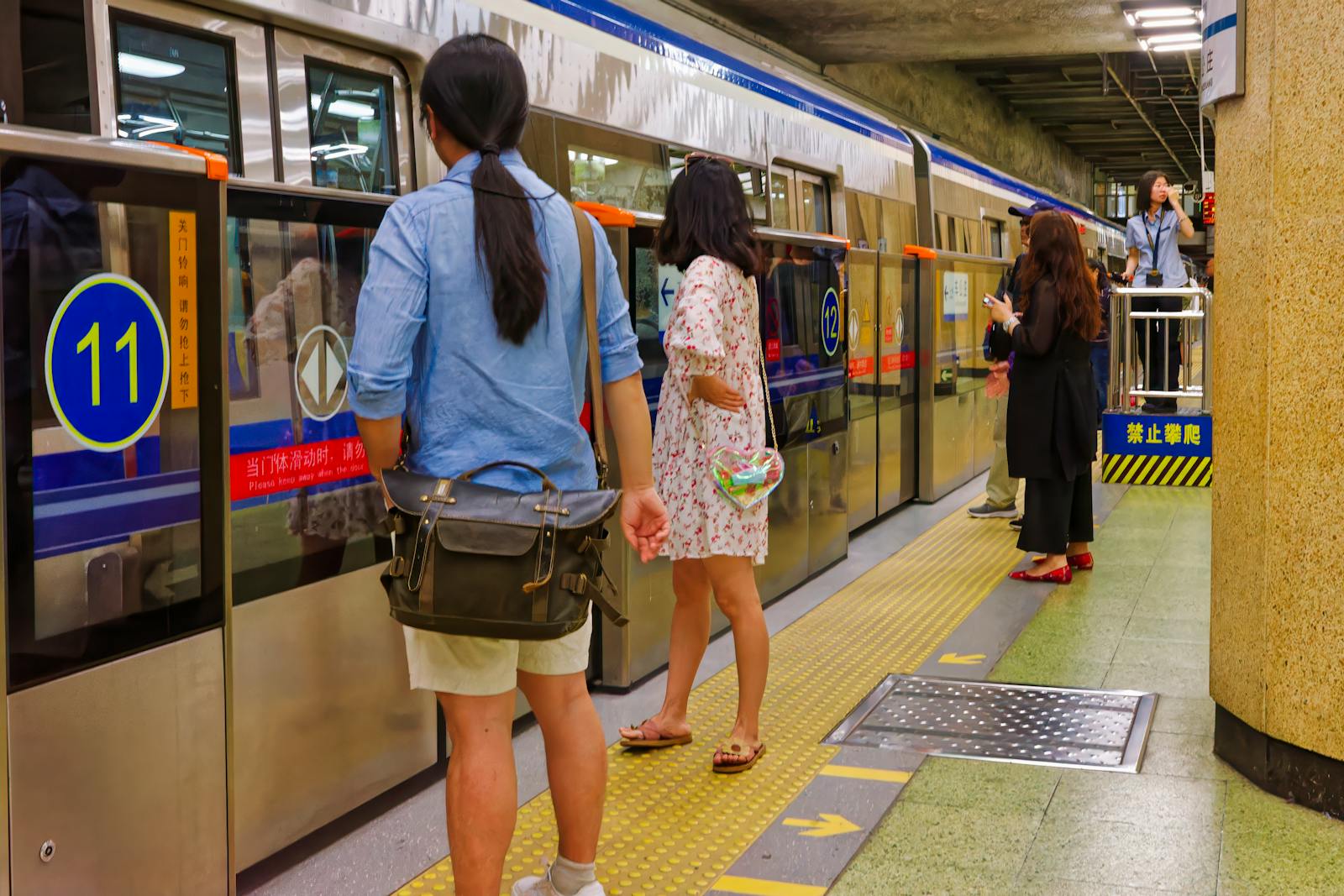
Signage is bilingual throughout — station names, platform indicators, line maps and on-board announcements all in Chinese and English (some announcements add Japanese on tourist-heavy lines). Every station entrance has a security check: bags go through an X-ray, and water bottles are sometimes inspected with a hand-held device or a request to take a sip.
A note on transfers
Transfers between lines at major hubs — Xizhimen, Dongzhimen, Guomao, Beijing South Railway Station — can involve five-minute walks through long corridors. Plan for an extra ten minutes per change if travelling with luggage. Lifts exist but are not always next to the platform; escalators sometimes run only in one direction during off-peak hours.
Buying tickets and paying
Single-trip tickets are sold from contactless machines at every station entrance. Machines accept cash (¥1, ¥5, ¥10 notes; ¥1 and ¥0.50 coins), QR-code payment via WeChat Pay or Alipay (with a Chinese bank account or, increasingly, a foreign card linked through the apps' tourist-mode), and contactless cards. Foreign credit cards are now accepted at machines on a growing number of central lines, rolled out gradually since 2023.
Distance-based fares run ¥3 for the first 6 km, then ¥1 added every 4–7 km thereafter, with a network maximum of ¥9. A trip from Tiananmen East to the Summer Palace's East Gate runs ¥6; from Beijing South Railway Station out to the Great Wall railhead at Badaling, ¥9. Daily cap is ¥150, which is rare to hit unless making genuinely cross-city journeys all day.
For repeat travel across more than a couple of days, the Beijing Transportation Card (Yikatong, 一卡通) is the simplest option. Sold at every station kiosk for a ¥20 refundable deposit plus topped-up value, it works on subway, bus and some taxis — tap in, tap out, fare deducted. Discount of about 50% on bus fares with the card. Refunds are processed at airport stations and a handful of central locations on departure.
Taxis and the dominant fleets
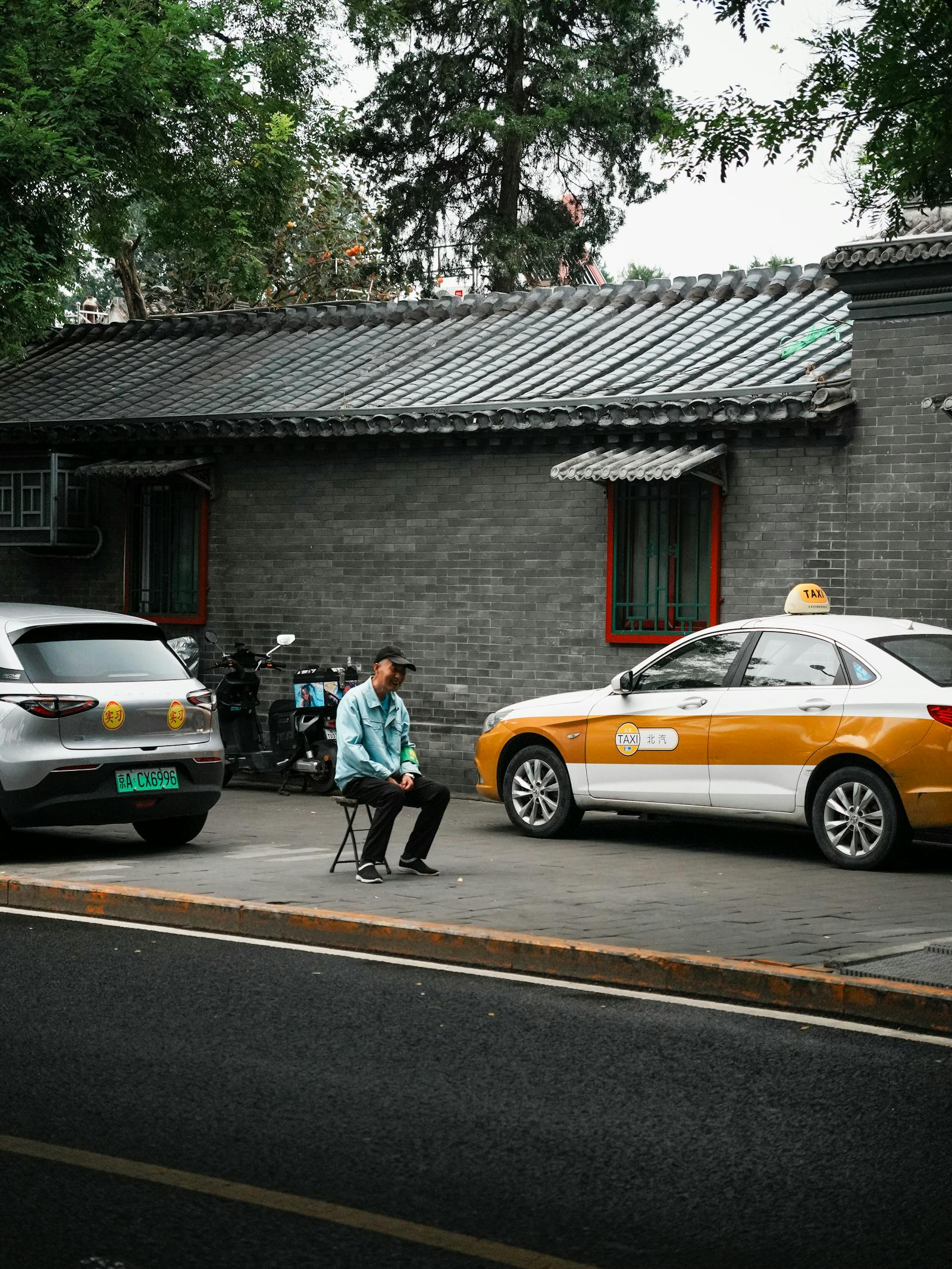
Around 70,000 licensed taxis operate in Beijing. Liveries are yellow with a secondary colour that varies by company — Beijing Capital Taxi (Shouqi), Beiqi, Beijing Yinjian and Jinjian are the major operators, each with thousands of vehicles. All are metered and bilingually signed; the meter sits on the dashboard with the fare displayed in red LED.
Base fare is ¥13 for the first 3 km, then ¥2.30 per kilometre. A ¥1 fuel surcharge is added per trip, and any expressway toll appears at the end (typically ¥10–20 across the city). A 20% surcharge applies between 23:00 and 05:00. Phone-booked or app-booked rides carry an extra ¥6 booking fee. Cash, WeChat Pay, Alipay and the Yikatong card are accepted by most drivers; foreign credit cards generally are not.
Hailing on the street is reliable in central Beijing during daytime hours. It becomes harder in the morning rush, in heavy rain, and during the late-evening shift change around 16:30–17:30 when many drivers refuse longer fares because they need to return the vehicle to the depot. Empty taxis show a red 空車 (kōngchē, "empty") light on the dashboard.
Drivers' English is limited. Visitors are well served by carrying a written address in Chinese characters — most hotels keep a stack of bilingual taxi cards at the front desk for this exact purpose — or by showing a destination pin on Apple Maps or 高德 (Gaode, the dominant Chinese mapping app) on a phone screen.
DiDi for foreigners
DiDi (滴滴出行, Dīdī Chūxíng) is the dominant ride-hail platform in mainland China, with several tiers visible to most users: DiDi Express (快车, the standard service), DiDi Premier — operated as Shouqi (首汽) — and DiDi Hitch (a carpool option). Until recently the platform required a Chinese phone number and a domestic bank-linked payment method, which kept it out of reach for short-stay visitors. That changed in 2023–2024.
An international version of the DiDi app now accepts foreign phone numbers and major foreign credit cards in Beijing and a handful of other Chinese cities. Visitors download the app, register with a passport-issued phone number, add a card, and book in English. Maps and addresses appear in English for the rider; the driver sees Chinese.
Express fares are roughly ¥10 base plus ~¥2.50 per kilometre — slightly less than a metered taxi over short distances, slightly more once tolls and surge pricing kick in. Premier (Shouqi) is more expensive but the cars are newer and English-speaking drivers turn up more often. A trip across the centre — say, Wangfujing to 798 Art District — runs ¥40–70 on Express, ¥80–120 on Premier.
For a visitor without a Chinese SIM card, DiDi was a closed door until 2024; now it is the easiest way to cross the city after 23:00.
Buses, bikes and walking
Beijing's bus network covers what the subway does not: roughly 700 routes operated by some 24,000 buses, with a flat ¥2 fare on most routes (¥1 with the Yikatong card). Bus stops are bilingual at every stop sign, and route numbers are shown in Arabic numerals. Buses run from approximately 05:30 to 22:30; a few night routes run later, marked with an "N" prefix.
For short hops within a district, dockless rental bikes — Hellobike (哈啰), Meituan Bike and a couple of smaller operators — are scattered on every corner. Unlock by scanning the QR code on the frame through WeChat or the operator's app; rates run ¥1.50 for the first 15 minutes and ¥0.50 for each additional 15 minutes. A foreign credit card linked to WeChat is usually enough to register; some apps still require a Chinese ID number, which is a friction point.
Walking inside a district is genuinely good. Around the Forbidden City, Tiananmen Square and Beihai Park, the imperial axis is walkable end to end in 40 minutes. The hutong neighbourhoods around Houhai and Nanluoguxiang invite long aimless walks at any hour. Between districts, however, central Beijing is too spread out — the ring roads alone are 30 km across — and walking gives way to subway or DiDi.
Beijing Transportation Card
The Yikatong (一卡通) card is the single most useful object for any visitor staying more than three days. Sold at every subway station ticket window for a ¥20 refundable deposit plus topped-up value, it covers subway, bus and some taxis with a single tap.
- Buy at any station kiosk (cash or card; staff speak limited English but the transaction is rote)
- Top up at the same kiosks or at self-service machines in any station
- Tap in and tap out on the subway; tap once on buses
- Refundable at airport stations on departure (Beijing Capital and Daxing both have refund counters in the arrivals/departures concourse) and at a handful of central refund points listed on the card sleeve
- Lost cards forfeit the deposit and the loaded value — there is no replacement
What works for visitors
For a first-time visitor staying within the second and third ring roads, the practical pattern is: subway for any cross-city journey, DiDi or taxi for late evenings and rain, walking for everything inside a single district. A Yikatong card paid for on day one removes the friction of buying single-trip tickets at every station.
For comparison: London's Underground covers 402 km across 11 lines; Tokyo's Metro and Toei together cover roughly 304 km across 13 lines; Beijing's 800 km dwarfs both. Coverage is real, frequency is high, fares are low. What slows visitors is the security checks at every entry and the long transfer corridors at hub stations — both worth budgeting an extra ten minutes for.
A few specifics that catch first-time visitors: subway security checks add 2–5 minutes at busy stations; pre-paid bottled water is fine through X-ray, opened bottles sometimes prompt a sip request; rush-hour Line 1 and Line 10 trains regularly run at 130% of design capacity; and the last train often leaves earlier than the published time on outer-line stations during winter months. Plan accordingly.
For arrival from Beijing's two airports, see the Beijing airport transfer entry covering PEK and PKX. Once in the city, the imperial axis is reached easily from any central station — see the Forbidden City and the hutongs around Nanluoguxiang for two of the most rewarding starting points. Further reading on the system itself is at english.bjsubway.com; on the city more broadly at Britannica and visitbeijing.com.cn; on DiDi at didiglobal.com.