no. five · imperial
Great Wall at Mutianyu: 22 watchtowers, less crowded
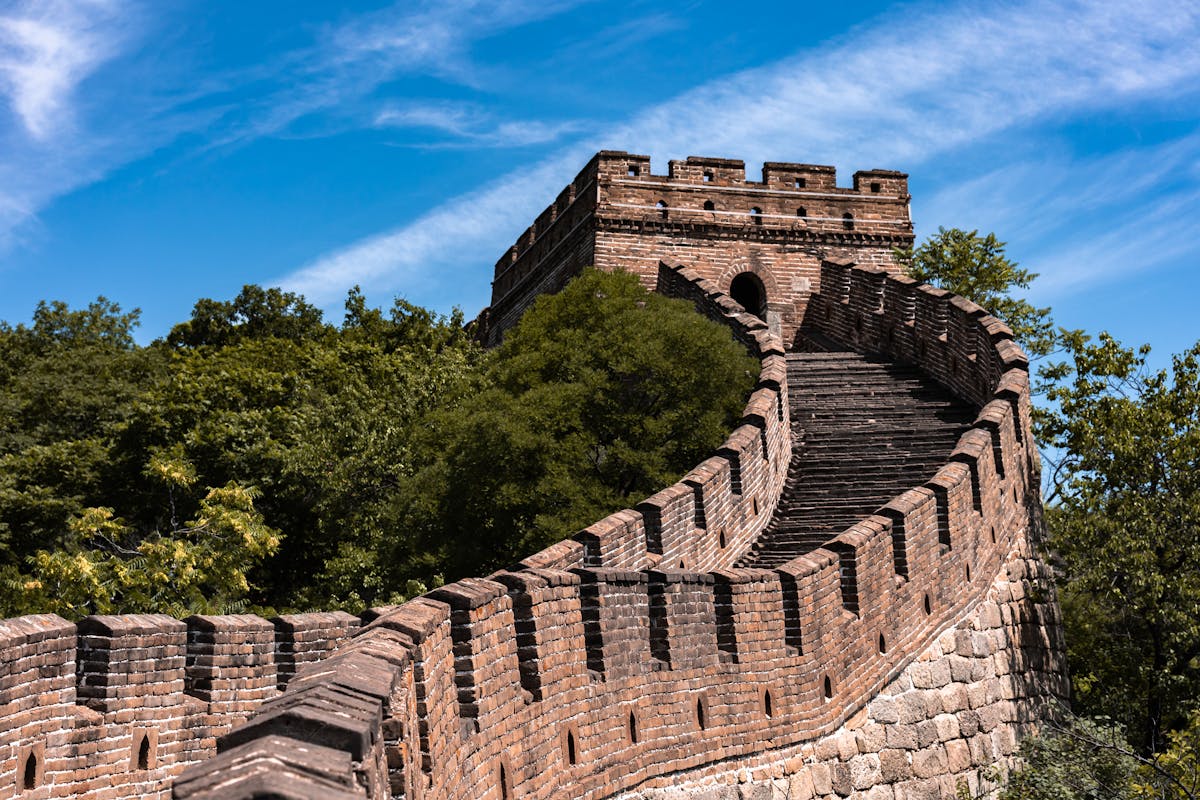
A 2.25-kilometre restored stretch of the Ming-era Great Wall in Huairou district, 75 km north-east of Beijing, with 22 watchtowers along a forested ridge. Less crowded than Badaling, more accessible than Jinshanling — the most workable Wall day-trip from the city for most visitors.
- Location
- Huairou District, ~75 km north-east of central Beijing
- Length restored
- 2.25 km, 22 watchtowers along a forested ridge
- Built
- 1568–69 under General Qi Jiguang, Ming Wanli reign
- Admission
- ¥45 entry; cable car / chairlift / toboggan ¥80–120 each, separate
- Hours
- 07:30–17:30 Apr–Oct; 08:00–16:30 Nov–Mar (last entry 1 hr before close)
- Access
- Tour bus from Dongzhimen Hub; or Subway Line 16 + bus 916 + bus h23 (2.5 hr by transit); private taxi ¥600–1,000 round-trip
In the spring of 1568, a Ming general named Qi Jiguang — better known for his earlier campaigns against pirates on the Zhejiang coast — was reassigned north to oversee the rebuilding of the wall guarding the approach to the capital from the Mongolian steppe. The stretch he ordered rebuilt at Mutianyu, 75 kilometres north-east of what was then Beiping, replaced an older Northern Qi rampart that had stood, in some form, on the same ridge since the sixth century. Twenty-two watchtowers went up across 2.25 kilometres of forested ridgeline. Most of them are still standing, and most of what a visitor walks today is the wall Qi Jiguang built.
That density of towers — roughly one every hundred metres — is the highest of any restored section open to the public, and the visual signature of Mutianyu against any photograph of Badaling or Jinshanling.
Geography and length
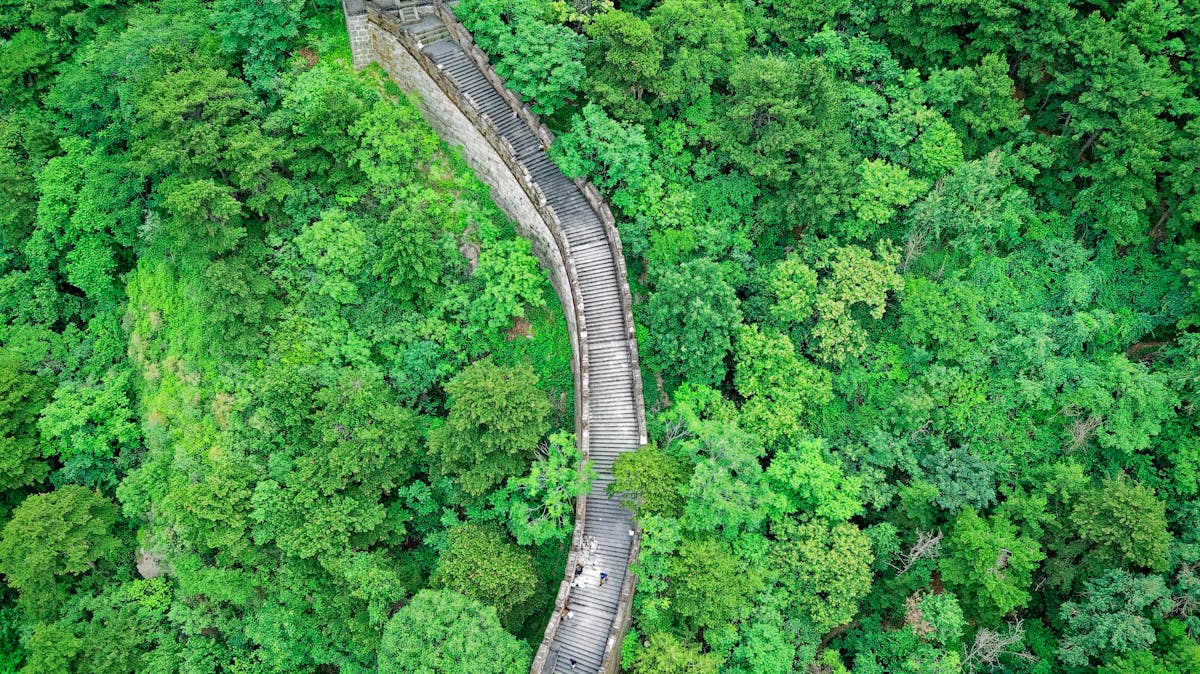
Mutianyu sits in Huairou District, on the northern fringe of the Beijing municipality, within a fold of the Yan mountains. A visitor approaches by road through Huairou town — itself an hour from the centre of Beijing in light traffic — then climbs another twenty minutes up a single-lane road that ends at a small valley with car parks, a market street, and three pieces of vertical infrastructure carrying people up to the ridge above.
Along that ridge, restored wall runs for 2.25 kilometres between Tower 1 at the western end and Tower 23 at the eastern. Wall thickness measures 7 to 9 metres at the base; height varies between 4 and 5 metres above the walking surface. A walker following the full open section between Tower 6 (where the cable car arrives) and Tower 23 covers a little over a kilometre and a half on top of the wall itself, with elevation gain and loss totalling around 250 metres. Most parties do this in 2 to 3 hours, with stops.
Beyond Tower 23 to the east, the wall continues unrestored toward Jiankou — a famously ruined section much loved by hikers but not officially open. Beyond Tower 1 to the west, an unrestored stretch likewise drops away into the woods. The fenced area covers only the central restored portion.
The Ming-era restoration
Qi Jiguang's 1568–69 reconstruction belongs to the broader Wanli-era programme of fortifying the northern frontier, after the Ming court spent much of the sixteenth century absorbing Mongol raids that reached as close as the outskirts of Beijing itself. Mutianyu was a strategic gap: a low pass through the Yan range that mounted cavalry could exploit if undefended. The wall closes that gap.
What stands today was substantially rebuilt a second time in the 1980s, when Beijing municipality undertook the restoration that opened the section to the public in 1987. Stones were re-set, watchtower roofs reconstructed, and the walking surface levelled. Purists sometimes describe the result as more reconstruction than ruin — accurate enough — but the underlying line, the tower placement, and the ridge geometry remain Qi Jiguang's.
Compare with Jinshanling, where roughly half of what is open is unrestored or only partially stabilised: at Mutianyu, the entire 2.25 km is finished surface, with handrails on the steepest sections.
On the towers
Each of the 22 watchtowers at Mutianyu has two storeys: a lower level with arrow slits at three sides and a doorway through to the wall walk, and an upper level reached by an internal stair, originally roofed and now mostly open to the sky. Towers 6, 8, 14, and 20 retain the most intact upper rooms. Tower 14 sits at the highest accessible point of the open section and gives the longest views west and east along the ridge.
Compared with Badaling and Jinshanling
Three sections of restored wall draw the bulk of day-trip visitors from Beijing: Badaling (the closest and busiest), Mutianyu (this one), and Jinshanling (further away, partly unrestored). For most visitors with a single day to give to the Wall, Mutianyu is the workable middle.
Badaling is closer — about 60 km from central Beijing — and reachable by a direct high-speed train that drops passengers within a five-minute walk of the entrance. The trade-off is crowds. On summer weekends and Chinese national holidays, Badaling queues for the cable car can run to ninety minutes, and the wall walk itself becomes shoulder-to-shoulder.
Jinshanling sits further still — 130 km north-east, more than two hours by road — and offers a longer, more atmospheric walk including unrestored stretches that crumble into the trees. It is the choice for visitors with a full day, an interest in the wall's ruined state, and a willingness to commit to a longer commute.
Mutianyu falls between. Less crowded than Badaling on most days, and especially so on weekday mornings; less remote than Jinshanling, and more accessible to families and older visitors thanks to the three vertical-transport options that remove the steepest stair climb from the equation.
| Section | Distance from city | Restored length | Crowd level | Best for |
|---|---|---|---|---|
| Badaling | ~60 km NW | ~3.7 km | Heavy | Time-pressed first visit, train access |
| Mutianyu | ~75 km NE | 2.25 km | Moderate | Most day-trip visitors, families, older walkers |
| Jinshanling | ~130 km NE | ~10 km partly restored | Light | Hikers, photographers, full-day commitment |
Cable car, chairlift, toboggan, stairs
Three pieces of vertical infrastructure carry visitors up to the ridge. A fourth option — the stairs — costs nothing but takes about thirty minutes of steep climb to reach the wall walk.
- Cable car — round-trip ¥120, runs to Tower 14 (the highest accessible point). The most direct option for visitors aiming at the central viewpoint.
- Chairlift — round-trip ¥120, an alternative ascent that lands closer to Tower 6 at the western end of the open section.
- Toboggan — one-way descent only, ¥100. A metal slide running 1.5 km down the hillside next to the chairlift, popular as a return option after walking the ridge.
- Stairs — free, roughly 30 minutes up, on a broad stone path that climbs through pine forest to a point near Tower 6.
The most common combination among day-trip visitors: chairlift up to Tower 6, walk eastward along the ridge to Tower 14 or further, toboggan back down. That sequence keeps the steepest climbing off the legs and ends with the toboggan, which by general agreement is more entertaining than the cable car as a way of leaving.
Getting there
Mutianyu has no rail connection. Three transport modes carry visitors from central Beijing: tour bus, public-transit relay, and private car.
By tour bus, the Mubus service departs from the Dongzhimen Outer Hub roughly every thirty minutes between 07:00 and 09:30, with return services running until early evening. One-way fare is around ¥30; journey time runs 1.5 hours each way in normal traffic. Tickets are sold from a counter at the hub and from the official site, mutianyugreatwall.com.
By public transit, a relay of three legs gets visitors to the wall: Subway Line 16 to Beidiana, then bus 916 from there to Huairou bus terminal (roughly an hour), then a transfer to bus h23 for the final 40 minutes to Mutianyu. Total time is 2 to 2.5 hours, total cost under ¥20. Workable, but unforgiving on timing — missing the last h23 back to Huairou (typically around 17:00) means a taxi or a walk back into town.
By private car, a hired taxi or car service runs ¥600 to ¥1,000 for the round-trip with waiting time, depending on negotiation and vehicle. Hotel-organised tours typically run ¥150 to ¥300 per person. For visitors who want to combine Mutianyu with another site — the Ming Tombs, for instance — a private car is usually the only way that fits in a day.
When to come
April through May, and September through October, give the most reliable weather: clear skies, moderate temperatures, leaves on the trees in spring or in colour in autumn. June heat is bearable; July and August are not — peak crowds combine with high humidity and a real risk of haze that closes in the longer ridge views.
Winter at Mutianyu is colder than central Beijing — typically 5 to 8°C lower on the ridge — but quieter, and on a clear day after fresh snow the section is at its most photogenic. The toboggan operates year-round; the chairlift sometimes closes for high winds.
For any season, weekday morning is the right window. The site opens at 07:30 from April to October and at 08:00 from November to March; gate traffic is lightest in the first ninety minutes after opening. Last entry is one hour before close, but visitors who arrive that late will not have time to walk and catch transport back. Plan to be on the wall by 10:00 at the latest.
For wider context, see the Forbidden City entry on Beijing's other Ming-era constructions, or the Summer Palace entry for the Qing successor to imperial-era landscape architecture. Onward logistics — taxis, DiDi, the metro back to a hotel — are covered in getting around Beijing.
UNESCO inscribed the Great Wall as a single World Heritage property in 1987; Mutianyu falls within that listing, alongside Badaling, Jinshanling, and the unrestored sections beyond. Background on the inscription is at unesco.org/en/list/438; an authoritative historical overview is available via Britannica; municipal practical information is published at visitbeijing.com.cn.