no. four · imperial
Summer Palace: 290 hectares of imperial garden
The largest surviving imperial garden in China — three-quarters Kunming Lake, one-quarter Longevity Hill, with the 728-metre Long Corridor connecting the Hall of Benevolence to the Marble Boat. Used by the Qing court as their summer retreat from the heat of the inner city.
- District
- Haidian, NW Beijing · 15 km from the Forbidden City
- Built
- 1750–1764 by the Qianlong Emperor, over an earlier 12th-century Jurchen-era garden
- Area
- 290 hectares · roughly three-quarters water, one-quarter hill and pavilion
- Admission
- Combo ticket ¥30 winter (Nov–Mar) / ¥60 summer (Apr–Oct) · gate-only ¥20 / ¥30
- Hours
- 06:30–18:00 main entrance · smaller gates close earlier in winter
- Access
- Subway Line 4 to Beigongmen, exit C (North Palace Gate)
Walk the 728 metres of the Long Corridor end to end and 14,000 small painted scenes pass overhead — most drawn from Romance of the Three Kingdoms and Dream of the Red Chamber, with mountain landscapes filling the gaps between figures. Each crossbeam carries a different image, repainted in the 1980s and again in the early 2000s on the original timber. Running along the north shore of Kunming Lake, the corridor connects the Hall of Benevolence and Longevity in the east to a stone boat moored at the lake's north-western corner.
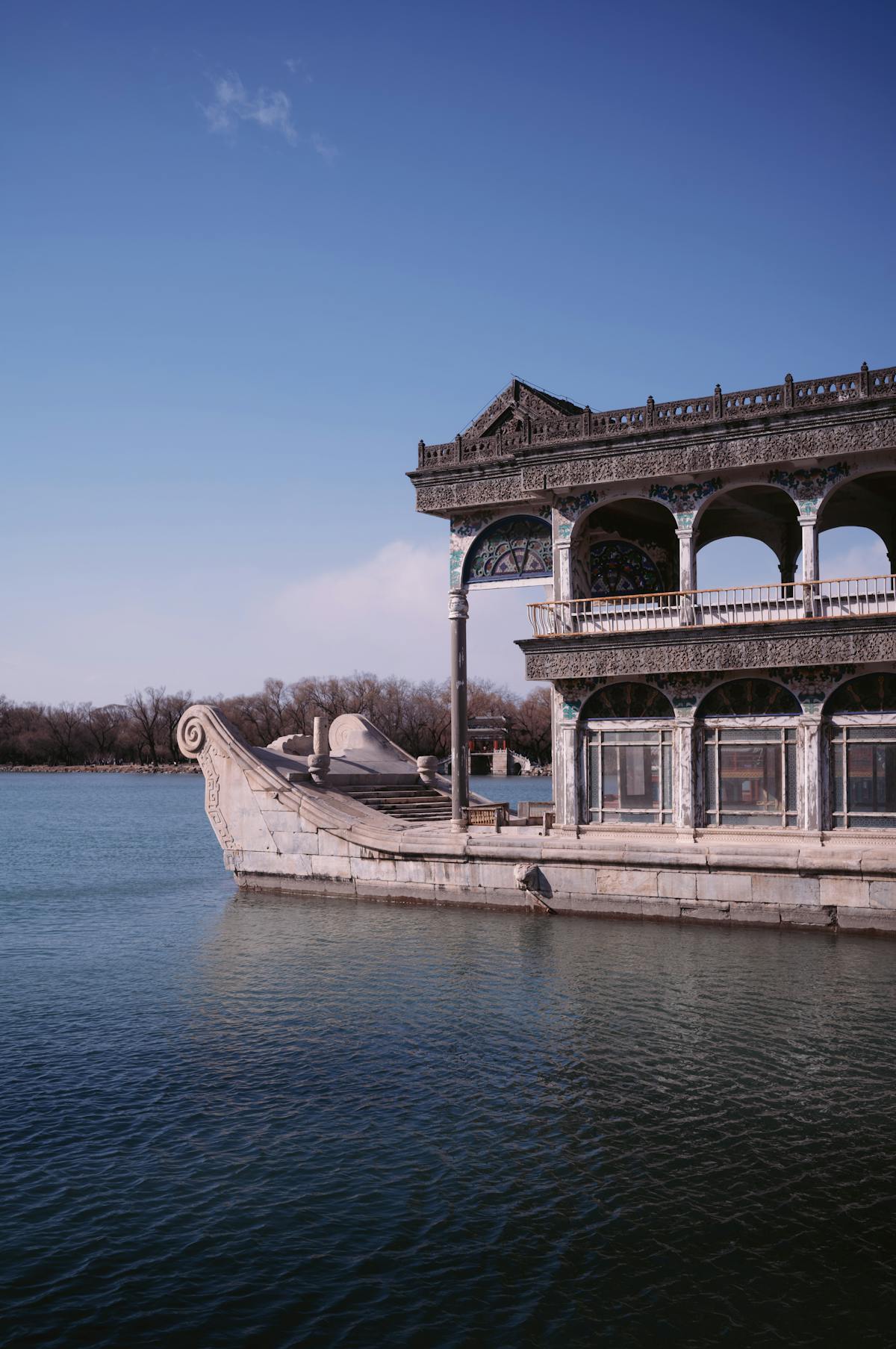
That stone boat — the Marble Boat, or Qingyanfang — was built in 1755 from blocks of carved white marble and sits permanently at its mooring, going nowhere. Empress Dowager Cixi added paddlewheels to it in 1893, decorative and immobile, and the addition has remained controversial ever since: she paid for the 1888 reconstruction of the whole palace, including the boat, with funds reportedly diverted from the budget that was meant to modernise the Imperial Navy.
Lake and hill
Two-hundred-and-ninety hectares, of which roughly 220 are water. Kunming Lake takes up three-quarters of the grounds; Longevity Hill, sixty metres at its highest, takes up most of the rest. Both are partly artificial. Qianlong's 1750s expansion of the existing pond used corvée labour to dig the lake out wider and deeper than the original Jurchen-period Jinshui reservoir, and the spoil was piled up onto the small natural rise on the northern shore to make a proper hill — high enough to set a pagoda on top, deliberately echoing the West Lake landscape at Hangzhou that the emperor had visited and admired.
Most pavilions sit on the south slope of Longevity Hill, looking out over the lake. A long bridge — the Seventeen-Arch Bridge, completed in 1750 and 150 metres long — runs from the eastern shore out to South Lake Island, where the Dragon King Temple sits. It ranks among the most photographed objects in Beijing, particularly in the few days each December when the setting sun aligns with all seventeen of its arches at once.
Built by Qianlong, rebuilt by Cixi
Construction ran from 1750 to 1764, costing — according to imperial accounting — 4.48 million silver taels. Qianlong dedicated it to his mother, the Dowager Empress Chongqing, on her sixtieth birthday, and named it the Garden of Clear Ripples (Qingyiyuan). It served as a working summer retreat: the court physically relocated here from the Forbidden City when the inner city's summer heat made the walled palace airless and unbearable.
In 1860, during the Second Opium War, Anglo-French forces burned both this garden and the much larger Yuanmingyuan a few kilometres east. Most timber halls were lost; stone bridges and the Marble Boat survived. The palace stood mostly in ruins for nearly thirty years.
Reconstruction began in 1886 under Empress Dowager Cixi and finished in 1888 — at which point she renamed it the Garden of Nurtured Harmony (Yiheyuan), the name it carries today. Funding came partly from money formally allocated to modernising the Beiyang Fleet, a redirection that historians have argued contributed to the Qing navy's catastrophic defeat by Japan at Weihaiwei in 1895. Damage came again in 1900 when the Eight-Nation Alliance entered Beijing during the Boxer Rebellion; Cixi commissioned a second restoration almost immediately afterwards. Listed by UNESCO as a World Heritage Site in 1998.
The Long Corridor and Marble Boat
Changlang — literally "Long Corridor" — was first built in 1750 and rebuilt to the original specification after the 1860 fires. It runs 728 metres in 273 sections, each section punctuated by a crossbeam. The painted scenes are the corridor's defining feature, but the structure itself is the longest covered walkway anywhere in Chinese garden architecture.
At the corridor's western end stands the Marble Boat. Two storeys of carved white stone on a granite platform, with stained-glass windows added in the 1893 restoration alongside the decorative paddlewheels. Cixi's apologists argue that the Marble Boat was a metaphorical statement — a permanent boat, an unsinkable vessel — at a moment when the actual fleet was about to fail. Her detractors say she simply liked it.
Practical note
The Long Corridor takes about 25 minutes to walk end-to-end at a steady pace, longer if pausing to look up at the painted scenes. School groups arrive in the eastern section around 10:00 most weekdays; the western half (towards the Marble Boat) is consistently quieter.
The Tower of Buddhist Incense
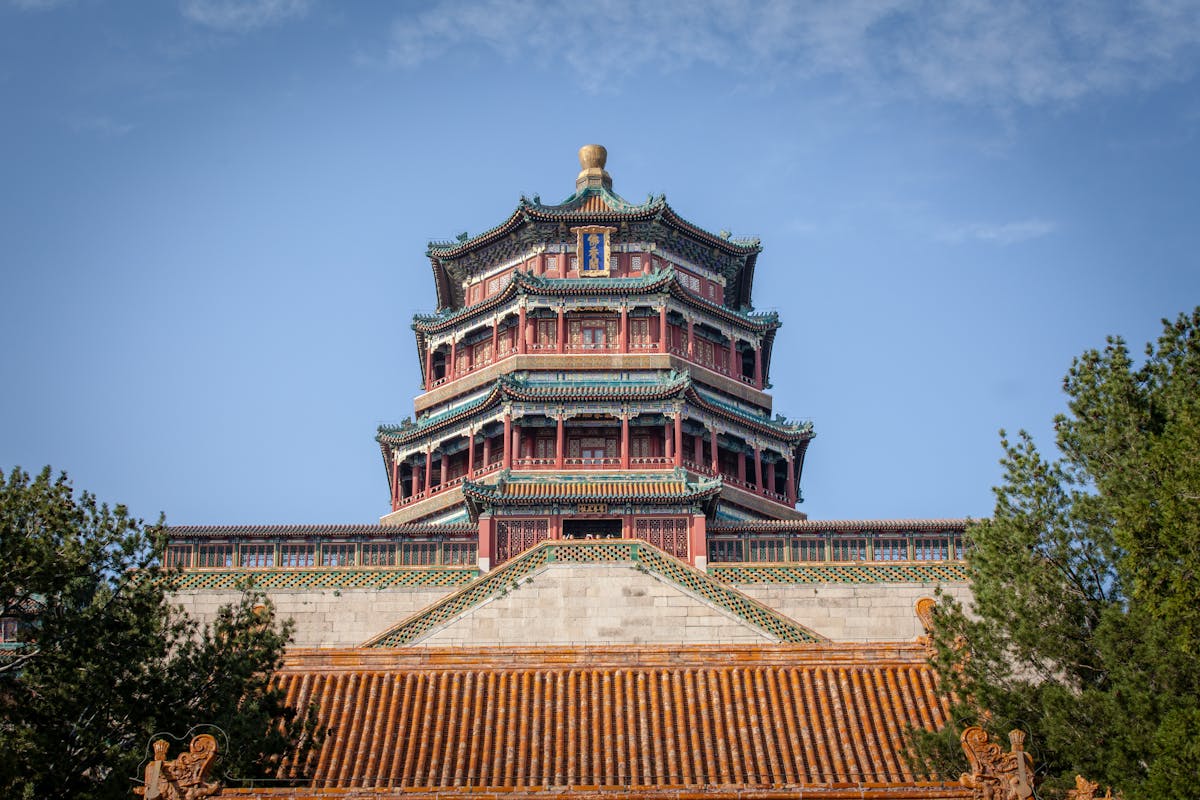
Foxiangge sits on the upper southern slope of Longevity Hill, 41 metres tall, eight-sided, four storeys, with a central column of Nanmu wood that runs the full height of the structure. From the upper galleries the entire lake is visible — Kunming Lake fills the foreground, the Western Hills rise behind, and on a clear day the city skyline appears in the eastern distance, fifteen kilometres away.
Built in 1750, burned in 1860 with everything else, and rebuilt in 1891 to its original three-storey design with an added fourth storey. A statue of the thousand-armed Guanyin sits on the ground floor. Climbing the tower costs ¥10 above the gate ticket; visitors pay at the door. Worth the climb for the sightline alone.
Below the tower, the Cloud-Dispelling Hall (Paiyundian) was Cixi's main reception room — where she received foreign envoys, including, in 1898, the wife of the Russian minister, who described the hall as cooler than any she had encountered in Peking. The hall sits on the central north–south axis that runs from the lake shore up to Foxiangge, with the marble Imperial Way carved with dragons cutting through the centre of the steps.
Boats on the lake
Three kinds of vessel cross Kunming Lake. Public passenger ferries run on fixed routes from the eastern Wenchang Pavilion dock to South Lake Island and across to the Marble Boat dock on the western shore — fares ¥10 to ¥20 one-way, departures roughly every 30 minutes from 09:00 to 16:30. Smaller electric pleasure boats, four-seaters with a canopy, rent at ¥120 per hour from rental docks at Wenchang Pavilion and at the western shore; an ID deposit (or ¥500 cash) is required.
A third option is a dragon-headed pleasure boat — a longer covered ferry painted to resemble an imperial barge — running tourist circuits at ¥20 per leg.
Crossing the lake by boat to the Marble Boat dock and then walking the Long Corridor back toward the eastern entrance is one of the more efficient ways to see the major features in a single half-day visit. The crossing itself takes about fifteen minutes. Boats stop running on windy days and in winter when the lake freezes.
Tickets, gates, time required
Two ticket types operate. A combination ticket (lianpiao) at ¥30 winter or ¥60 summer covers the gate entrance plus all four ticketed inner sites: the Tower of Buddhist Incense, Suzhou Street, the Wenchang Hall museum and the Garden of Virtue and Harmony (the imperial theatre). A gate-only ticket at ¥20 winter or ¥30 summer admits visitors but charges separately at each inner site (¥10–¥20 each). Combination tickets work out cheaper for anyone planning to enter two or more inner sites.
| Ticket type | Apr–Oct | Nov–Mar | Includes |
|---|---|---|---|
| Combo (lianpiao) | ¥60 | ¥30 | Gate + 4 inner sites |
| Gate only | ¥30 | ¥20 | Gardens, lakeside, Long Corridor |
| Tower of Buddhist Incense | ¥10 | ¥10 | Add-on, gate-only ticket |
| Electric pleasure boat | ¥120/hr | n/a (frozen) | Self-piloted, ¥500 deposit |
Two main gates serve the site. The East Palace Gate (Donggongmen), closest to subway Line 4 Beigongmen via a 25-minute walk, is the busiest entrance and where most tour buses arrive. The North Palace Gate (Beigongmen), directly above the subway station of the same name, is significantly quieter — and entering from the north drops visitors at the foot of Longevity Hill, near Suzhou Street, with the Tower of Buddhist Incense climb at the start of the visit rather than the end.
Three to four hours is the practical minimum. A full half-day allows time to walk the corridor, climb the tower, take the boat across, and explore South Lake Island.
A frozen lake in deep winter
From late December through early February, Kunming Lake freezes solid enough to walk on. A skating section is officially marked out and patrolled near the eastern shore — skate rental at ¥40 per hour, hours 09:00 to 17:00 weather-permitting — and the rest of the frozen surface is unofficially used by Beijingers on push-sleds and ice bikes. Entry fees are at the lower winter rate during this period.
Photographs of the Seventeen-Arch Bridge taken in clear winter weather are some of the better-known images of the city. Visitors hoping for the December solstice alignment should arrive at the eastern shore at least an hour before sunset.
Onward, see also the Forbidden City for the winter palace at the centre of the inner city, and Beihai Park for an older, smaller imperial lake garden inside the second ring road. Subway routes to and from this entry are covered in getting around Beijing.