no. six · the city
Lama Temple: Tibetan Buddhism in central Beijing
A 17th-century imperial residence converted into a Tibetan Buddhist monastery in 1744 by the Qianlong Emperor. The largest functioning lamasery in mainland China, holding the 18-metre standing Maitreya Buddha carved from a single sandalwood trunk.
- District
- Dongcheng, north-east of the Forbidden City
- Built
- 1694 as imperial residence; converted to monastery 1744
- Admission
- ¥25
- Hours
- 09:00–16:00 (last admission 15:30)
- Closed
- None — but very busy on lunar 1st & 15th
- Access
- Subway Line 2 / Line 5 to Yonghegong, exit C
In 1694, two decades into the reign of the Kangxi Emperor, a residence was built on the north-eastern edge of the inner city for his fourth son, Prince Yong. When Prince Yong took the throne in 1722 as the Yongzheng Emperor, the residence could no longer serve as a private home — by Qing convention, no living quarters used by an emperor could be inhabited again. Half the compound was given over to lamas. Twenty-two years later, in 1744, his son and successor Qianlong made the conversion total: the whole site became a Tibetan Buddhist monastery, and has remained one ever since.
Yonghegong — Palace of Harmony and Peace — is the formal name. Foreign visitors call it the Lama Temple. Around 70 Mongolian and Tibetan monks live and study on site today, and the smell of sandalwood incense drifts through every courtyard from morning until the gates close at four.
From imperial residence to lamasery
Prince Yong lived in the compound for almost three decades before his ascension. After 1722, half the buildings were retained for imperial archive use and half handed to lamas of the Gelug school — the dominant order of Tibetan Buddhism, founded by Tsongkhapa in the 14th century. Qianlong's full conversion in 1744 had a political edge as much as a religious one. By installing the Gelug school at the Qing imperial centre, the emperor cemented relations with Mongolia and Tibet, both of which fell under the dynasty's outer realm. Yonghegong became the bureaucratic and ceremonial hub of Qing patronage of Tibetan Buddhism for the next 150 years.
It survived the chaos of the 20th century better than most. Premier Zhou Enlai is said to have personally intervened during the Cultural Revolution to keep the compound from being destroyed; the gates were locked, the monks dispersed, but the halls and statues remained. The temple reopened in 1981 and has functioned continuously since.
A note on the Gelug school
The Gelug — sometimes called the "Yellow Hat" school — is one of four major orders of Tibetan Buddhism and the order to which the Dalai Lama and Panchen Lama belong. Yonghegong's halls, statuary and ritual cycle reflect Gelug practice specifically; visitors familiar with Han Chinese Buddhist temples will notice the difference immediately in iconography, prayer wheels, and the use of butter lamps.
The five main halls
Yonghegong is laid out on a strict south-to-north axis, a sequence inherited from Chinese palace architecture rather than Tibetan monastic planning. Five major halls follow one another, each a step deeper into the compound and, by tradition, a step deeper into the path of the bodhisattva.
- Heavenly Kings Hall (Tianwangdian) — entry. Four guardian Heavenly Kings flank the doorway; a smiling Maitreya — the future Buddha, in his pre-incarnation form — sits in the centre.
- Hall of Harmony and Peace (Yonghegong main hall) — three Buddhas of past, present and future. The throne used by the Yongzheng Emperor when the building was an imperial residence still stands here.
- Hall of Eternal Protection (Yongyoudian) — the original imperial throne hall, now home to bronze Buddhas in the Tibetan style.
- Hall of the Wheel of the Law (Falundian) — a six-metre statue of Tsongkhapa, founder of the Gelug school, surrounded by a Tibetan-Mongolian sutra collection of more than 200 volumes.
- Pavilion of Ten Thousand Happinesses (Wanfuge) — the northernmost building. Three storeys high, designed around the Maitreya Buddha that fills its entire central shaft.
Side halls flanking the axis hold further bronzes, thangkas and ritual objects; two stand out. A Wash-Buddha basin, carved from a single nanmu wood trunk, was used in ritual bathing of statues at the new year. Nearby, in a side hall east of Falundian, the Five Hundred Arhats Mountain — a single block of sandalwood carved into a mountain landscape populated by hundreds of small figures — rewards a careful look.
The Maitreya Buddha
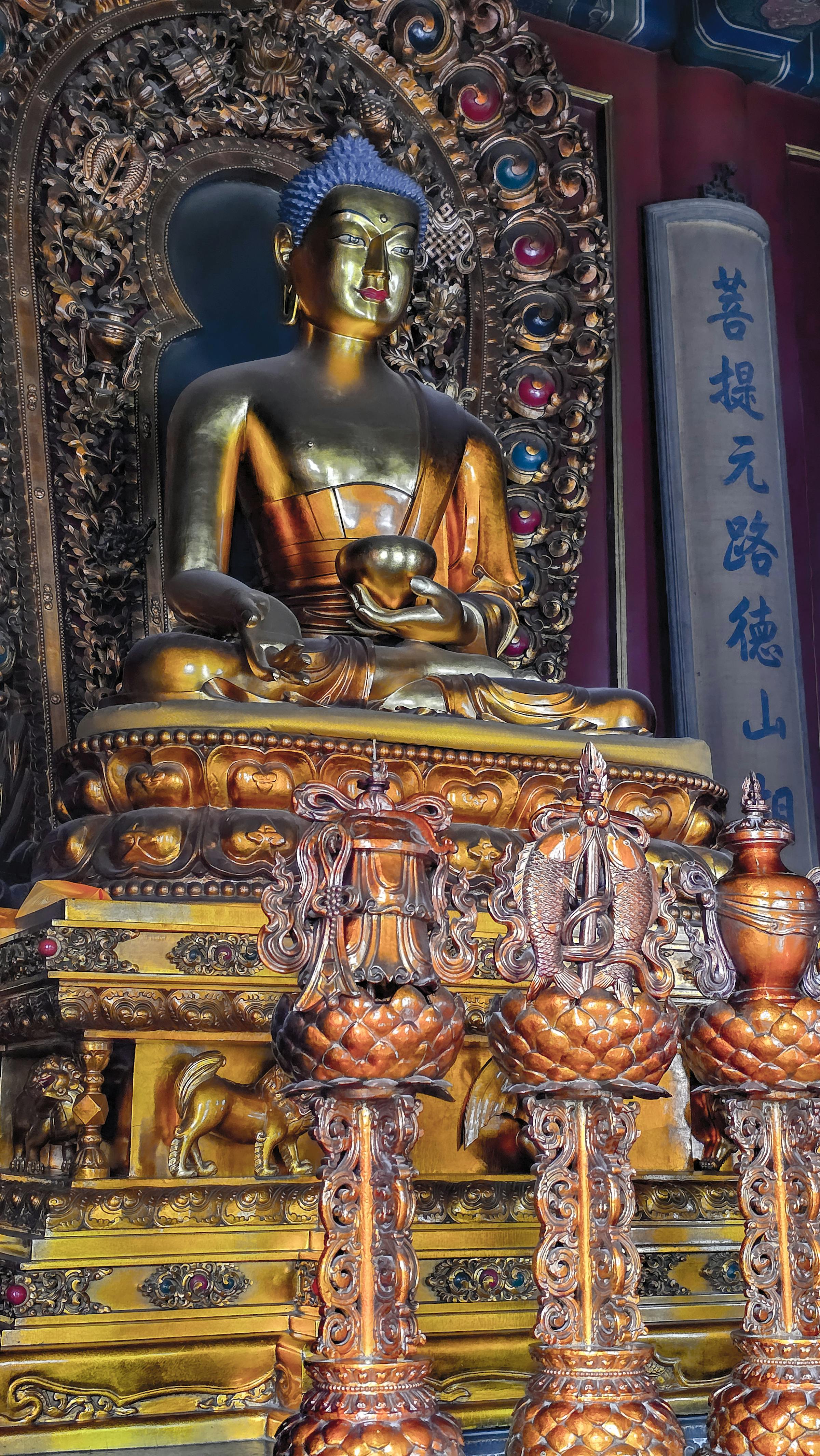
What everyone comes for stands in the final hall. Inside the Pavilion of Ten Thousand Happinesses, the Maitreya rises 18 metres from the floor — 8 metres of which sit underground, anchoring the rest — and was carved from a single trunk of white sandalwood imported from Nepal via Tibet, a gift from the Seventh Dalai Lama to the Qianlong Emperor in 1750. Some sources count the foundation differently and give the total height as 26 metres. Either way, Guinness recognised it in 1990 as the largest Buddha statue carved from a single piece of wood.
This pavilion was built around the statue, not the other way round. Two flying galleries on the upper storeys allow viewing at chest and head height, and the head — barely visible from the ground floor — only resolves into clear features from the third level.
One trunk, three storeys, eighteen metres standing — the only way the building works is if the statue went in first.
Photography inside the pavilion is restricted, and signage explicitly forbids flash. Photography in the courtyards between halls is permitted, including the burning of incense in the bronze braziers — a key visual element of any visit.
Festival days and crowds
Yonghegong is a working monastery, and its calendar follows the lunar cycle. On the first and fifteenth of every lunar month, Beijing residents arrive in numbers to burn incense and pray; the queue for the entrance gate can reach Yonghegong subway station, several hundred metres away. Spring Festival — Chinese New Year, late January or February — is the heaviest period of the year, with a queue that can extend along Yonghegong Dajie for half a kilometre and waits of two to three hours.
For visitors aiming to actually see the halls rather than experience the ritual crowd, lunar festival days should be avoided. Most guides print a Chinese lunar calendar, and hotel front desks will check on request. Outside festival days, weekday mornings before 11:00 are the lightest window; school groups arrive after lunch.
Tickets and access
Admission is ¥25 — a token price by international museum standards, deliberately set to keep the temple accessible for Beijingers as a place of worship rather than a tourist attraction. Free incense sticks are distributed at the entrance gate, six per visitor. Many local visitors bring much more, and the air inside the larger braziers becomes genuinely thick by mid-morning; visitors with respiratory sensitivity may want to skip festival days entirely.
Access is via Yonghegong station on Subway Lines 2 and 5, exit C. The temple gate is 200 metres north of the station along Yonghegong Dajie. Cabs and DiDi cars drop off at the same point. Cash or Alipay at the ticket window; foreign cards are not accepted, and the queue for the foreigner-friendly automated kiosks (when working) is sometimes longer than the cash queue.
| Item | Detail |
|---|---|
| Admission | ¥25 adult · ¥12.50 student with ID · free under 6 |
| Hours | 09:00–16:00 daily, last admission 15:30 |
| Subway | Yonghegong, Line 2 / Line 5, exit C |
| Avoid | Lunar 1st & 15th, Spring Festival week |
| Photography | Permitted in courtyards, restricted in halls, no flash |
| Time on site | 2 hours minimum, 3 comfortable |
Adjacent: the Confucian Temple
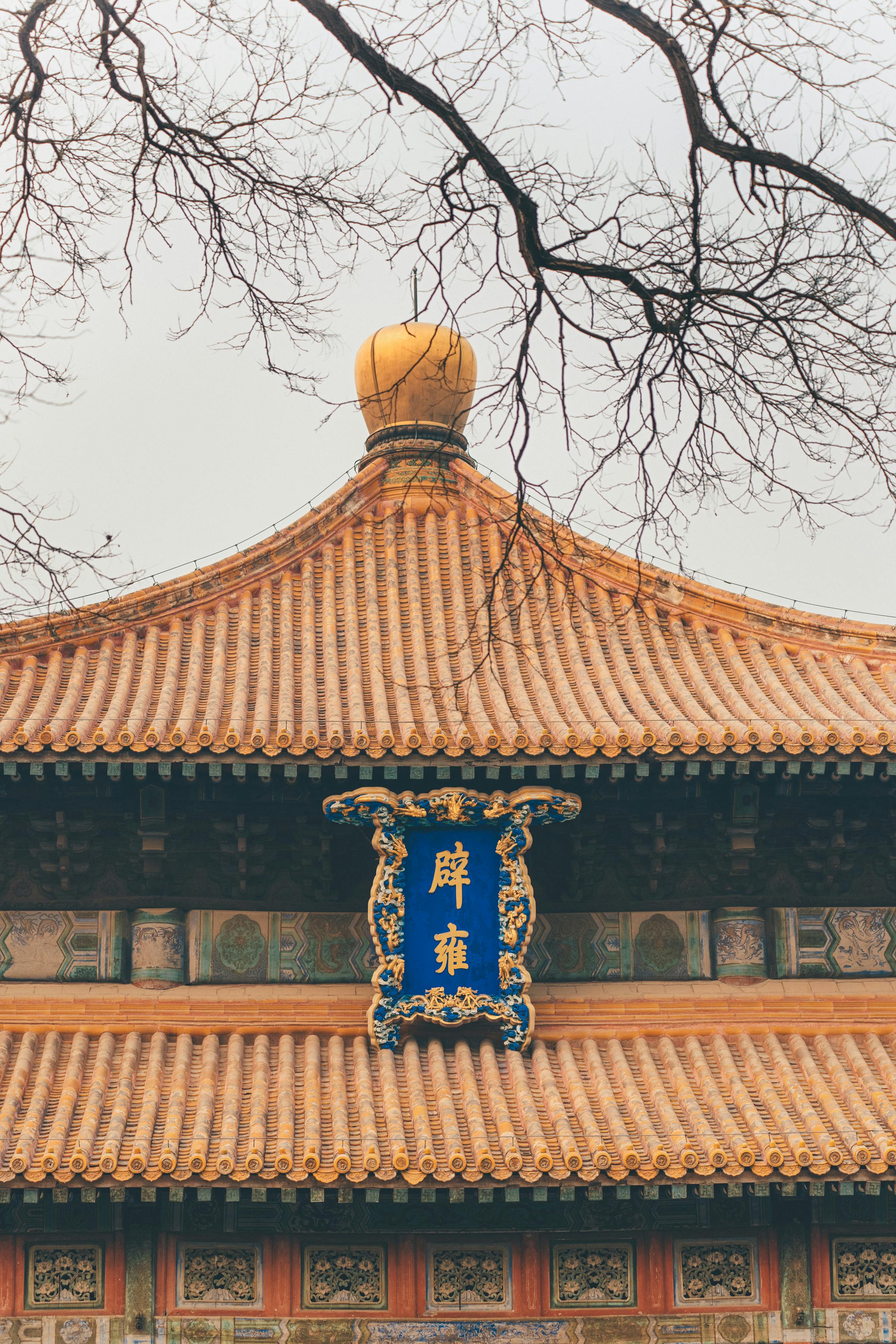
Two hundred metres west of Yonghegong, down a hutong called Guozijian Jie — one of the few streets in Beijing still flanked by traditional pailou archways — sits the Imperial Confucian Temple and its adjacent Imperial Academy (Guozijian). Twinned and originally administratively linked, both compounds together formed the apex of the Confucian education system from the Yuan dynasty through the end of the Qing in 1911. Inside the Confucian Temple stand 198 stone tablets engraved with the names of every successful palace examination candidate from 1416 to 1904 — the imperial civil service's complete graduate roll for nearly five centuries.
Admission is a separate ¥30 ticket; both compounds keep the same hours as Yonghegong. The combination of the two — Tibetan Buddhist monastery and Confucian academy on adjacent blocks — is unusual even in Beijing, and a morning at one followed by an early lunch and an afternoon at the other works well. Visitors interested in the broader UNESCO context for Beijing's imperial-era heritage can consult UNESCO's listings; for primers on the schools of Tibetan Buddhism represented at Yonghegong, Britannica's Tibetan Buddhism entry is a serviceable starting point. Practical Beijing visitor information is maintained at visitbeijing.com.cn.
For visitors continuing the day onward, the Nanluoguxiang hutongs are a 25-minute walk south-west, the Forbidden City is two stops on Line 5 plus a short walk, and the getting around Beijing entry covers DiDi, taxis and the rest of the metro grid.