no. nine · the city
Beihai Park: an imperial garden a thousand years old
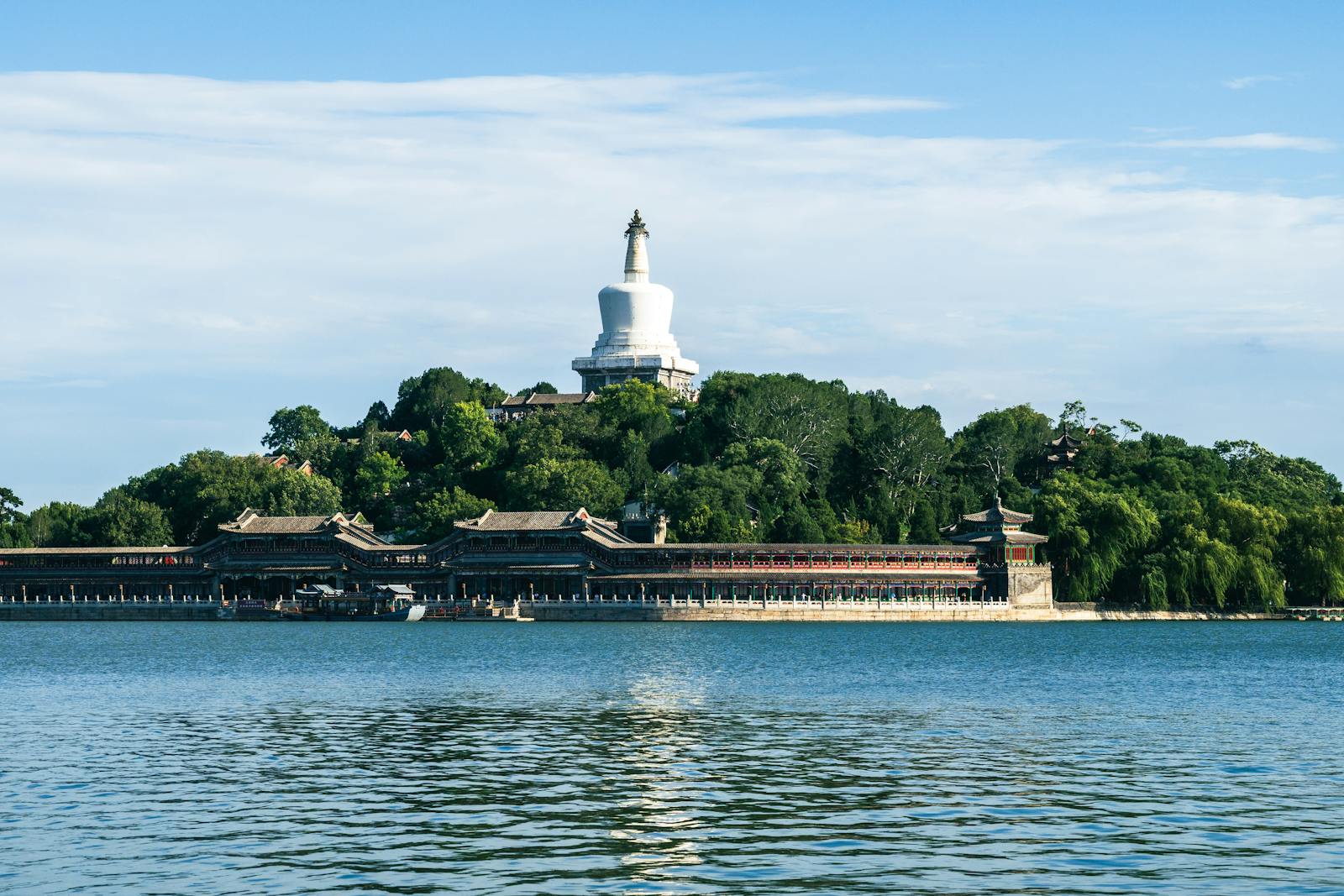
One of the oldest, largest and best-preserved Chinese imperial gardens, north-west of the Forbidden City. The 36-metre White Pagoda on Jade Flower Island dominates the lake. Used by the courts of Liao, Jin, Yuan, Ming and Qing — a near-millennium of continuous imperial gardening.
- District
- Xicheng, just north-west of the Forbidden City
- Origin
- Liao dynasty, 10th century; rebuilt under Yuan, Ming and Qing
- Area
- 69 hectares — about half lake, half land
- Admission
- ¥10 summer (Apr–Oct) · ¥5 winter (Nov–Mar)
- Hours
- 06:30–21:00, daily
- Access
- Subway Line 6 to Beihai North; or Line 1 to Tiananmen West + 10-minute walk
Beihai is older than the Forbidden City by some three hundred and fifty years. A pleasure garden was first laid out here in the 10th century by the Liao, the dynasty that ruled northern China before the Mongols arrived; the lake was already a fixed feature of the city when Kublai Khan made it the centrepiece of his Yuan capital in the 13th century, expanding the water and building a summer palace on its largest island. Five dynasties later, the basic plan — a lake, an island in the lake, a temple on the island — survives essentially intact.
Sixty-nine hectares lie inside the park's perimeter wall, and roughly half of that is water. Jade Flower Island sits centred in the southern half of the lake, crowned by a white Tibetan-style stupa visible from most of the surrounding hutongs and from the upper floors of the Forbidden City to the south. Walking from the south gate, around the lake's east shore, across to the island and back via the north shore takes three to four hours at folio pace, less if visitors skip the temple climb.
A thousand years of imperial gardening
Liao courtiers came here first, around the year 938, when their southern capital sat where Beijing now sprawls. Their successors, the Jin, kept the garden and added pavilions. Then in 1264 Kublai Khan chose this lake as the literal centre of his new capital, Khanbaliq — the city Marco Polo would describe a generation later — and built his summer palace on what is now Jade Flower Island. The Yuan court enlarged the lake by digging out earth and piling it onto the island; the resulting hill is essentially man-made, raised by Mongol shovels seven and a half centuries ago.
Ming emperors moved their primary residence south to the new Forbidden City in the early 15th century but kept Beihai as an imperial back garden, a private retreat across the wall. Qing rulers, who took the Forbidden City in 1644 without much fighting, inherited Beihai with it and continued to use it for the next two and a half centuries. The garden opened to the public only in 1925, thirteen years after the Qing fell.
A near-millennium of continuous use
Few gardens anywhere have been continuously gardened for as long. Five dynasties — Liao (10th c.), Jin (12th c.), Yuan (13th–14th c.), Ming (14th–17th c.), Qing (17th–early 20th c.) — each added something here and removed less than they added. What remains is layered, not unified, and that layering is part of why UNESCO and the Encyclopaedia Britannica treat Beihai as the canonical surviving example of the Chinese imperial garden tradition.
The White Pagoda on Jade Flower Island
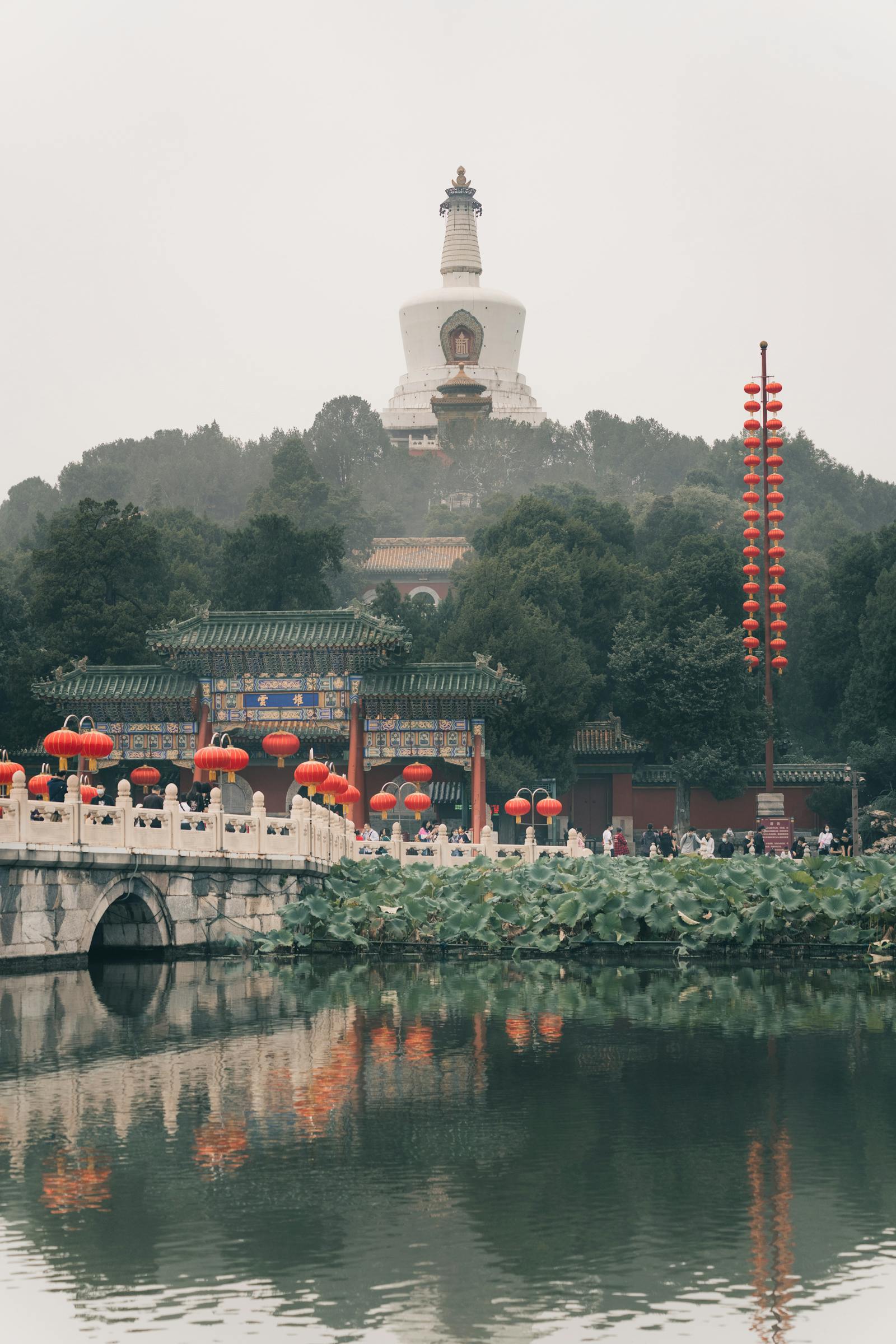
Bai Ta — the White Pagoda — is the visual signature of the park and visible from most of central Beijing's older neighbourhoods. It is thirty-six metres tall, Tibetan-style (a bell-shaped stupa rather than the more familiar tiered Chinese pagoda), and was built in 1651 by the Shunzhi Emperor to mark the visit of the Fifth Dalai Lama to the Qing court. An earthquake in 1976 cracked the structure; it was rebuilt to the original drawings the same year.
The pagoda sits on top of Jade Flower Island, reached either by the bridge from the south gate or by a small ferry that runs in summer. Climbing the island's main path takes ten to fifteen minutes from the bridge, with stone steps switching back through pine and cypress. From the platform at the pagoda's base, the view extends south to the gold-tiled roofs of the Forbidden City, west to the Western Hills on a clear day, and north to the Drum and Bell towers.
Below the pagoda, on the island's south face, stands Yongan Temple — the Temple of Eternal Peace — a Ming-era Buddhist complex still in religious use. Its halls are arranged on the slope between the bridge and the pagoda, so most visitors walk through them on the way up whether or not they intend to.
The Nine Dragon Screen and the Round City
On the north shore, set into a small walled court, stands the Nine Dragon Screen — Jiulongbi — a 27-metre wall of glazed ceramic tiles depicting nine coiling dragons in seven colours. It was built in 1402, near the start of the Ming, and is one of only three surviving Nine Dragon Screens in China. The other two stand inside the Forbidden City and in the Shanxi city of Datong; this one is the largest, and the only one freestanding rather than backed against a building.
The screen reads from left to right as a single composition. Yellow, the imperial colour, is reserved for the centre dragon; the flanking eight are blue, white, purple, ochre. Tile slip and salt damage have been steady problems for two centuries, and conservators replace cracked tiles every decade or so from the original kilns' surviving stock.
South of the lake, just inside the south gate, stands Tuancheng — the Round City — a small walled enclosure raised on a brick platform. Two objects inside it justify the detour. One is a 200-year-old white-jade Buddha, two metres tall, which the Empress Dowager Cixi had moved here from Burma in the late 19th century. The other is the Black Jade Wine Vat, a Yuan-dynasty drinking vessel carved from a single block of jade, originally commissioned around 1265 for Kublai Khan's banquets. It is the oldest object in continuous public display in Beijing — seven hundred and sixty years and counting.
The north shore: Five Dragon Pavilions
Wulongting — the Five Dragon Pavilions — sit on the north-west bank of the lake, projecting out over the water in a connected zigzag chain. They are Qing-era, built in the late 17th century for fishing parties and moon-viewing. Each of the five pavilions has a different roof shape; visitors walk between them on covered bridges built directly on the water's surface.
This stretch of the north shore is where most local Beijingers spend afternoons. Retirees play Chinese chess on the stone tables under the willows; calligraphers practise on the paving stones with brushes dipped in plain water, the characters fading as they write. The atmosphere is residential, not touristic — the south gate near the Forbidden City carries most of the foreign-visitor traffic.
Boats in summer, skating in winter
From mid-April to mid-October, paddle boats and small electric boats can be rented from a kiosk on the eastern shore at ¥80 to ¥120 per hour, with a ¥200 cash deposit. Boats are limited to the southern half of the lake, around Jade Flower Island, and must be returned by 18:30 in summer or 17:00 in early autumn.
From early December until the first week of February, in most years, the lake freezes solid enough for skating. Beihai's rink is the main winter rink for central Beijing — larger and more central than Houhai's — and skate hire is run from a temporary booth near the eastern shore at ¥40 per hour for blades, ¥60 for ice chairs (a wooden seat on runners, used by elderly skaters and small children).
The lake is half the garden. The other half is whatever season has frozen, thawed, or flowered around it.
Tickets and gates
Admission is sold at all four gates — south, east, north, west — for ¥10 in summer (April through October) and ¥5 in winter (November through March). Entry to Jade Flower Island and the White Pagoda area is included; entry to the Round City costs an additional ¥1. All gates accept WeChat Pay, Alipay and cash; foreign-issued cards do not work at the kiosks, so cash or a Chinese mobile-payment account is required.
The south gate sits opposite the north-west corner of the Forbidden City and gets the heaviest tour-group traffic. The north gate, by the Nine Dragon Screen, is the quietest and is closest to the subway. Visitors arriving on Line 6 emerge essentially at the north gate's threshold; those arriving on Line 1 walk ten minutes north from Tiananmen West and enter at the south gate.
- South gate — closest to Forbidden City; busiest; opens onto the Round City and the bridge to Jade Flower Island
- East gate — opens onto the boat-rental kiosk and the eastern shore path
- North gate — closest to Subway Line 6 (Beihai North station); opens directly onto the Nine Dragon Screen court
- West gate — least used; opens onto the Five Dragon Pavilions area
Time required
Two to three hours covers the essentials: the Round City, Jade Flower Island including the climb to the White Pagoda, the south-shore walk to the Nine Dragon Screen on the north side, and the Five Dragon Pavilions. Adding a paddle-boat hour brings the visit to four hours; treating the park as an afternoon-and-into-evening, including a tea pavilion stop and the lit pagoda after dusk, brings it closer to five.
Most foreign visitors combine Beihai with the Forbidden City — the two share a wall — by exiting the Forbidden City through its north gate (Shenwumen), crossing the road, and entering Beihai by its south gate. This is the most direct walking route in central Beijing between two imperial sites, and removes one subway transfer from the day.
For broader context on imperial Beijing, see the Forbidden City entry — Beihai's southern neighbour and historical sibling. For another lake-and-garden experience further out, see the Summer Palace. And for the lakes immediately north of Beihai, see the Houhai lakes entry — the chain of three lakes (Qianhai, Houhai, Xihai) that runs north from Beihai's wall and forms one of central Beijing's most-walked evening districts. Onward planning is in the Beijing tourism authority listings, which keep current admission and seasonal-closure information.