no. three · imperial
Temple of Heaven: where emperors prayed for harvest
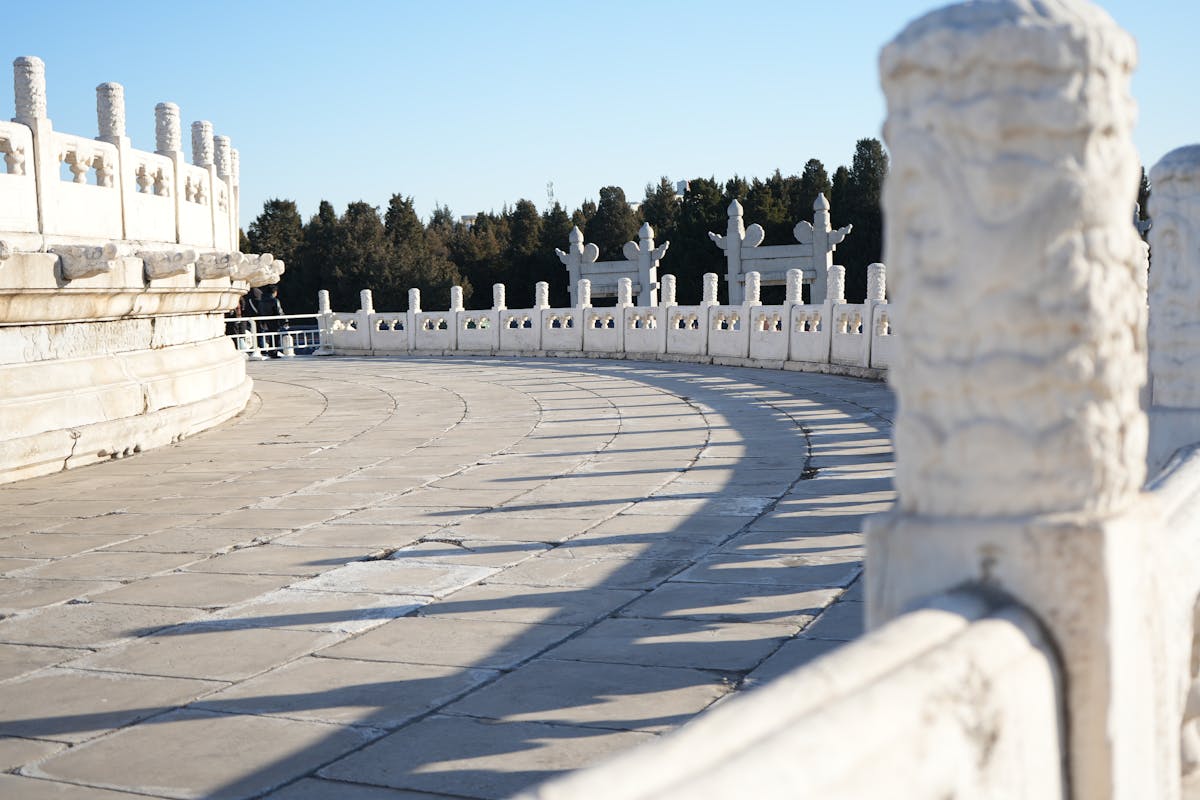
The Hall of Prayer for Good Harvests on a circular triple-tiered marble base, built in 1420 and rebuilt in 1889 after a lightning fire. Ming and Qing emperors visited each winter solstice for the harvest ceremony — now a UNESCO site and morning gathering place for the city.
- District
- Dongcheng, south of the Forbidden City along the central axis
- Built
- 1406–1420 under the Yongle Emperor; expanded mid-16th century by the Jiajing Emperor
- Park area
- 273 hectares — roughly four times the footprint of the Forbidden City
- Admission
- Combo ¥35 summer / ¥28 winter; park-only ¥15 / ¥10
- Hours
- Park 06:00–22:00 year-round; main buildings 08:00–17:30 summer, 08:00–17:00 winter
- Access
- Subway Line 5 to Tiantan East Gate; or Line 8 to Tiantandongmen
Construction began in 1406 under the Yongle Emperor — the same ruler who began the Forbidden City four kilometres to the north — and finished in 1420. From that year until 1911, every reigning Ming and Qing emperor walked the same route south through the imperial city to this complex twice a year: once for the winter solstice ceremony of prayer for the harvest, once for the summer ceremony of prayer for rain.
Grounds inside the outer wall cover 273 hectares, four times the area of the Forbidden City itself. Within that perimeter sit three principal ritual structures on a single north-south axis, a long elevated walkway joining them, and a substantial park of cypress and pine that locals have used as a daily exercise ground for at least a century.
The complex on the north-south axis
Three buildings sit in a line. From north to south: the Hall of Prayer for Good Harvests (Qiniandian), then the Imperial Vault of Heaven (Huangqiongyu), then the open-air Round Altar (Huanqiu). A raised stone causeway 360 metres long, called the Danbi Bridge, connects the first two.
An axis of this kind is not unique to Beijing — the Forbidden City sits on the same one — but at Tiantan it carries a specifically cosmological meaning. Round structures represent heaven; square enclosures represent earth. Each principal building here is round, and each sits inside a square outer wall. North is curved at its top; the southern wall is straight. Walking the causeway from south to north is meant to read as ascent from earth toward heaven, and the path was reserved for the emperor alone during ceremonies.
The Hall of Prayer and the 1889 rebuild
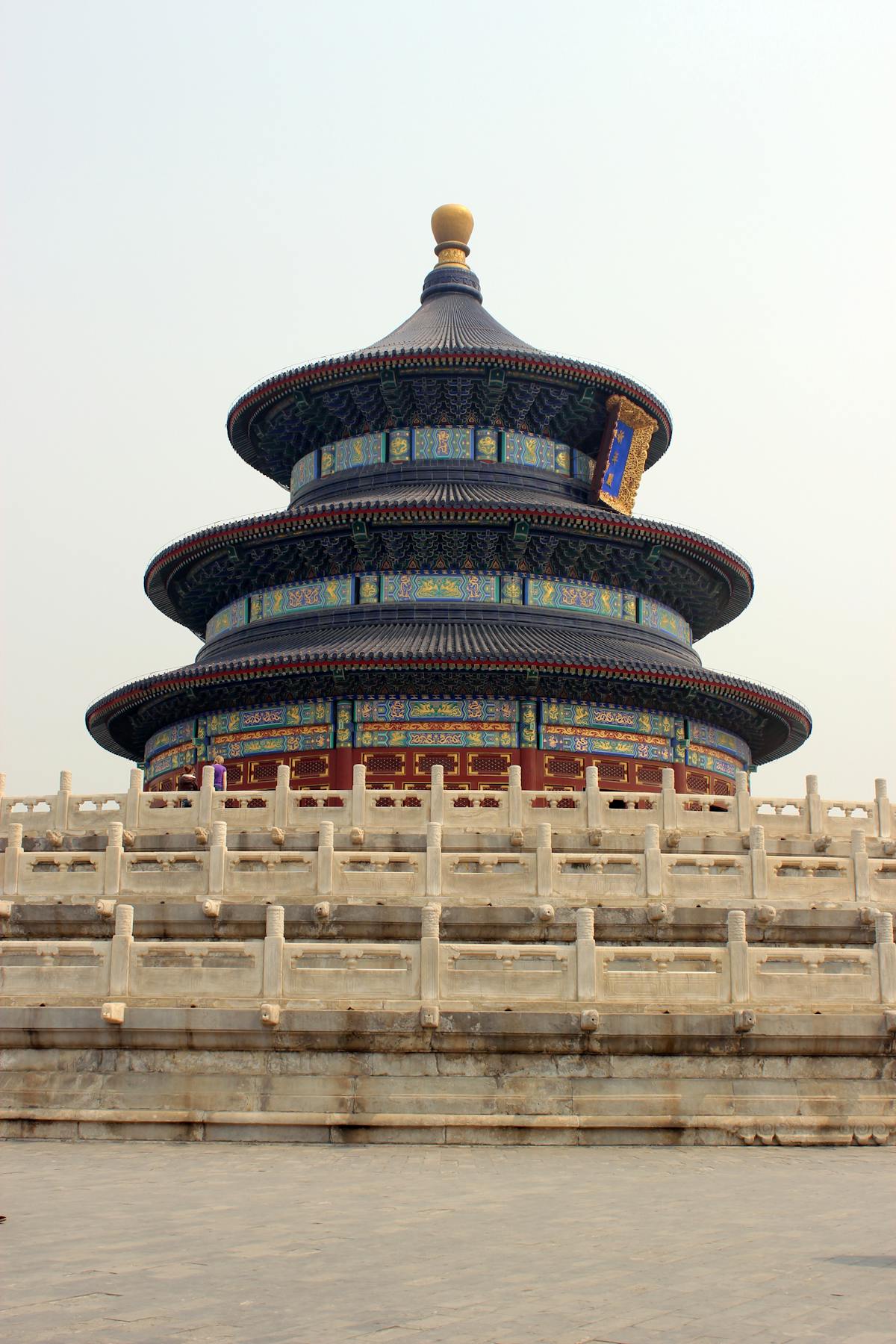
Qiniandian is what most photographs of the complex show: a 38-metre circular wooden hall with a triple-tiered conical roof of deep blue glazed tile, set on a triple-tiered white marble platform six metres above ground. Twenty-eight columns hold the roof — four central columns for the seasons, twelve inner for the months, twelve outer for the two-hour periods of the day. No nails were used in the framing.
What stands today is not the original. On the night of 24 August 1889, lightning struck the hall and a fire destroyed the wooden structure entirely. Reconstruction began immediately under the Guangxu Emperor and finished by 1896, using cedar timber sourced from the southwestern provinces. Today's hall is faithful to the Ming proportions but not literally Ming-era wood.
That detail is rarely mentioned on souvenir captions.
A practical note
Visitors entering through the South Gate read the buildings in ceremonial order — Round Altar first, Imperial Vault second, Hall of Prayer last — which is the order an emperor would have approached them. East Gate (the subway entrance) reverses this. Both are valid; the south approach is photographically better in afternoon light.
The Echo Wall and the Round Altar
South of the Hall of Prayer, the Imperial Vault of Heaven sits inside a smaller circular enclosure 65 metres in diameter. Its enclosing wall is the Echo Wall, and the acoustic anomaly along it is genuine: a whisper spoken close to the surface at one point on the circle travels along the curved face and is audible at the diametrically opposite point. Demonstrating the effect requires reasonable quiet, which the wall almost never has during daytime visiting hours.
Further south, the Round Altar (Huanqiu) is the most austere structure of the three — three open-air concentric marble tiers with no building above. This is where the actual sacrifice took place. Bullocks, jade, silk and grain were burned on iron braziers around the platform at the winter solstice; an emperor knelt at the centre stone of the top tier, called Tianxinshi, the Heart of Heaven Stone. Standing on that stone today, a person speaking at normal volume hears their own voice return amplified — another acoustic effect, this one created by the surrounding balustrades reflecting sound back at the centre.
Numerology and the solstice ceremony
Numbers across the complex are deliberate. Nine is the highest yang (odd, masculine, celestial) numeral, and the Round Altar is built almost entirely on multiples of nine: nine concentric rings of paving stones on the top tier (the innermost ring has 9 stones, the next 18, then 27, and so on outward to 81), nine stairs between each of the three tiers, nine balustrades on each radial division.
Winter solstice ceremony itself ran on a fixed protocol. An emperor processed from the Forbidden City along the central axis, fasted for three days at the Hall of Abstinence within the complex, and at dawn on the solstice climbed to the top tier of the Round Altar. Animal offerings were burned in iron furnaces; he then knelt at the Heart of Heaven Stone and read the prayer aloud. Ritual was repeated, with variations, for the summer prayer for rain and at lesser intervals for state emergencies — drought, plague, military reverse.
The last imperial ceremony at Tiantan was performed in 1914 by Yuan Shikai, a republican-era ruler attempting to declare himself emperor. He died eighteen months later; the ceremony has not been repeated.
UNESCO inscribed the complex on the World Heritage list in 1998, citing both the architecture and the surviving cosmological programme. Listing references are at unesco.org; broader background on Chinese ritual architecture is at britannica.com.
The park and its morning users
What surrounds the three monuments is, in practice, a public park. Cypress and pine — many of the cypresses are 500 years old, planted during the Ming reconstruction — fill the long approaches between the South Gate and the Round Altar, and between the East Gate and the Hall of Prayer.
From around 06:30 to 09:00 the park hosts what amounts to a daily civic gathering. Tai chi groups occupy the level paving in front of the Hall of Prayer's outer enclosure. Ribbon dancers — almost always women, almost always over sixty — work in the long gallery (Qihualaodian) on the eastern side. Kite flyers gather at the open ground south of the Round Altar where the air rises cleanly above the trees. Communal singing groups, a uniquely Beijing practice, take corners of the western pine grove and run through Maoist-era patriotic songs, Peking opera and folk standards in three-hour rotations.
Visitors arriving before 09:00 catch all of this; arriving after 10:30, almost none of it.
Tickets and access
Two ticket tiers exist. Park-only admission gets a visitor through any of the four gates and access to the grounds, but not into the three monuments — useful for a morning park visit or for people uninterested in the buildings themselves. Combo admission adds entry to all three principal structures plus the Hall of Abstinence and Long Corridor.
| Tier | Summer (Apr–Oct) | Winter (Nov–Mar) | Includes |
|---|---|---|---|
| Combo (Lianpiao) | ¥35 | ¥28 | Park + all three monuments |
| Park only | ¥15 | ¥10 | Grounds only, no buildings |
| Building surcharge | ¥20 | ¥20 | Bought separately if park-only ticket already in hand |
Subway Line 5 stops at Tiantan East Gate (Tiantan Dongmen) directly outside the eastern entrance. Line 8 stops at Tiantandongmen station — same name, slightly different transliteration, same place, since the lines interchange there. Buses 6, 34, 35, 36, 106 and 707 stop at the various gates. Visitors with mobility constraints should use East Gate; the path from East Gate to the Hall of Prayer is paved and largely level, while the South Gate route involves the long elevated causeway.
Allow two to four hours for a meaningful visit. Two hours covers the three main monuments at a brisk pace; four allows time in the park itself, the Hall of Abstinence, and the small complex of side halls north of the Hall of Prayer that most tour groups skip. Detailed visitor information is published by visitbeijing.com.cn.