no. ten · the city
Houhai Lakes: an evening on the imperial waterway
A connected series of three lakes — Qianhai, Houhai, Xihai — that formed the northern terminus of the Grand Canal in the 13th century. Today an evening district of bars, boats and lakefront walking, with the Drum and Bell Towers a short walk north.
- District
- Xicheng, north of the Forbidden City
- Lakes
- Qianhai, Houhai, Xihai — collectively Shichahai
- Origin
- Yuan dynasty, late 13th c. — Kublai Khan's Grand Canal terminus
- Admission
- Free perimeter; Prince Gong's Mansion ¥40
- Hours
- 24/7 perimeter
- Access
- Subway Line 6 to Beihai North; or Line 8 to Shichahai
Between 1289 and 1293, engineers under Kublai Khan extended the Grand Canal northward to a stretch of water in what is now north-central Beijing, allowing grain barges from the Yangtze delta to reach the new Yuan capital under sail. The water they reached was Jishuitan — three connected lakes that locals later called Shichahai, "Ten Buddhist Temples Lake," for the religious houses that once ringed their banks. The lakes are still here. The barges are not.
Qianhai (front lake), Houhai (back lake) and Xihai (west lake) cover roughly 34 hectares of open water. A combined perimeter walk runs about five kilometres. Free to enter at any hour, with individual sites — Prince Gong's Mansion, the Drum Tower, the Bell Tower — keeping their own ticket booths and hours. Most visitors come in late afternoon and stay through dusk.
Three lakes, one waterway
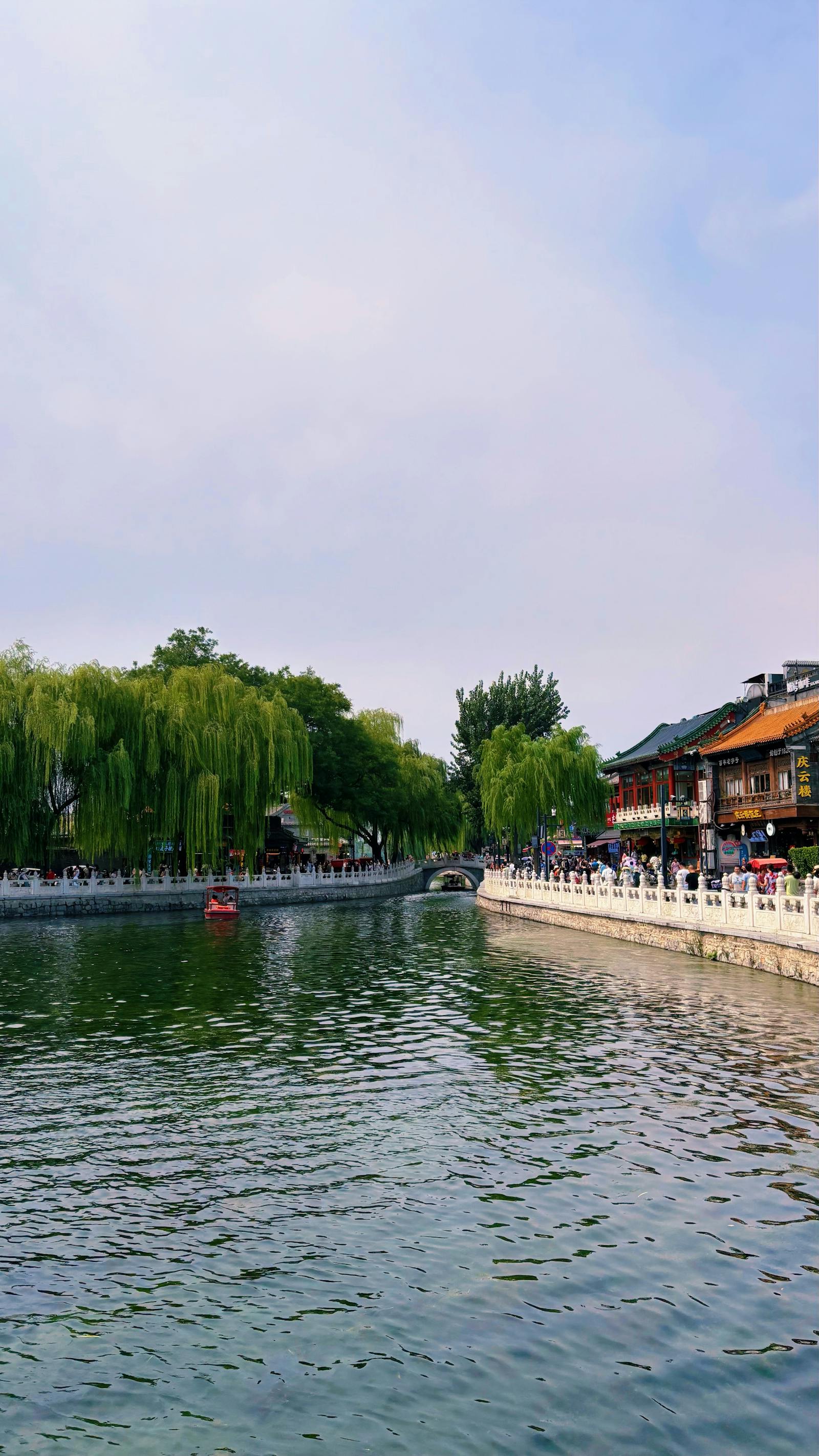
Shichahai is a single hydrological system rather than three separate ponds. Qianhai, the southernmost, is the smallest and the most theatrical — narrow, lined with willow, and crossed by Yinding Bridge ("Silver Ingot Bridge"), the stone arch that historically marked the boundary between Qianhai and Houhai. Houhai, the largest of the three, opens out behind the bridge into a long oval roughly a kilometre across at its widest. Xihai sits north-west of Houhai, smaller and quieter, ringed by residential blocks rather than bars.
Together the three are usually called Shichahai when speaking historically, and Houhai in casual conversation — the back lake's name has come to stand for the whole. Locals walk one or all three depending on the hour they have. A full circuit of Houhai alone takes about an hour at strolling pace.
Naming note
Three lakes, two names. Shichahai (什刹海) is the historical and bureaucratic name — used on maps, on the subway station "Shichahai" on Line 8, and in conservation documents. Houhai (后海) is the colloquial shorthand for the district as a whole, especially the bar-lined southern bank. Both refer, in practice, to the same place.
The canal terminus
Beijing under the Yuan dynasty (1271–1368) was a planned capital, and a planned capital needed grain. The Grand Canal — begun under the Sui in the 7th century, lengthened over centuries — already ran from Hangzhou to the area south of Beijing. Kublai Khan's hydraulic engineer Guo Shoujing was tasked with closing the final 80-kilometre gap, and between 1289 and 1293 he completed the Tonghui Canal, which fed water into the lakes that became Shichahai.
Grain barges then unloaded at the southern bank of Jishuitan, in what is now Houhai. Warehouses, dock workers, taverns and Buddhist temples grew up along the shore. UNESCO inscribed the Grand Canal as a World Heritage Site in 2014, and the Beijing terminus — though long defunct as a working dock — remains part of the protected ensemble. Britannica's entry on the Grand Canal covers the engineering history in more depth.
The dock infrastructure itself is gone. What remains is the water and the geometry: the canal-end shape of Houhai, the irregular shoreline of Qianhai, the surviving network of hutongs (alleyways) that ran from the docks into the imperial quarters of the Forbidden City to the south.
Drum and Bell Towers
Two Yuan-era marker buildings stand at the northern edge of the Houhai district, on a north-south axis that runs through the Forbidden City and out to the Bell Tower. The Drum Tower (Gulou) was first built in 1272 as the timekeeping centre of the Yuan capital; the present structure dates to a 1745 Qing-dynasty rebuilding after fire. The Bell Tower (Zhonglou), constructed slightly to the north, dates in its present form to 1747.
Both are climbable. Each tower keeps its own kiosk, each charges ¥20, both open 09:00–17:00 (last entry 16:30). The Drum Tower contains 25 reproduction drums on the upper level, with daily drumming demonstrations on the hour from 09:00 to 11:30 and 13:30 to 16:30. The Bell Tower's bronze bell — cast in 1420 and weighing 63 tonnes — is original; visitors climb 75 steep stone steps to reach it.
From the upper gallery of the Bell Tower, the entire Houhai basin is visible to the south, and on a clear winter day the Western Hills are visible beyond.
Prince Gong's Mansion
On the western edge of Qianhai stands Gong Wang Fu — Prince Gong's Mansion — the largest surviving Qing-dynasty princely residence in Beijing. Built in 1777 for He Shen, a Qing official who became the wealthiest individual in the empire before being executed in 1799 for corruption, the mansion was confiscated and held by the imperial household until 1851, when the Xianfeng Emperor granted it to his half-brother Prince Gong (Yixin), the diplomat who negotiated the 1860 Convention of Beijing.
The mansion covers roughly six hectares and divides into two halves: a residential complex of courtyards to the south, and a large classical garden to the north built around an artificial lake, rockeries, pavilions and a 156-metre covered corridor. Admission is ¥40 (¥20 for students), open 09:00 to 17:00 with last entry at 16:00. Closed Mondays in low season.
Inside the garden, look for the Fu (福, "fortune") character carved on a stone tablet behind glass — said to have been written by the Kangxi Emperor in 1673 and considered, by the superstitious, to be the luckiest single character in Beijing. Visitors queue to photograph it. Visit Beijing publishes current opening notices and event schedules in English.
Bars and boats: the evening district
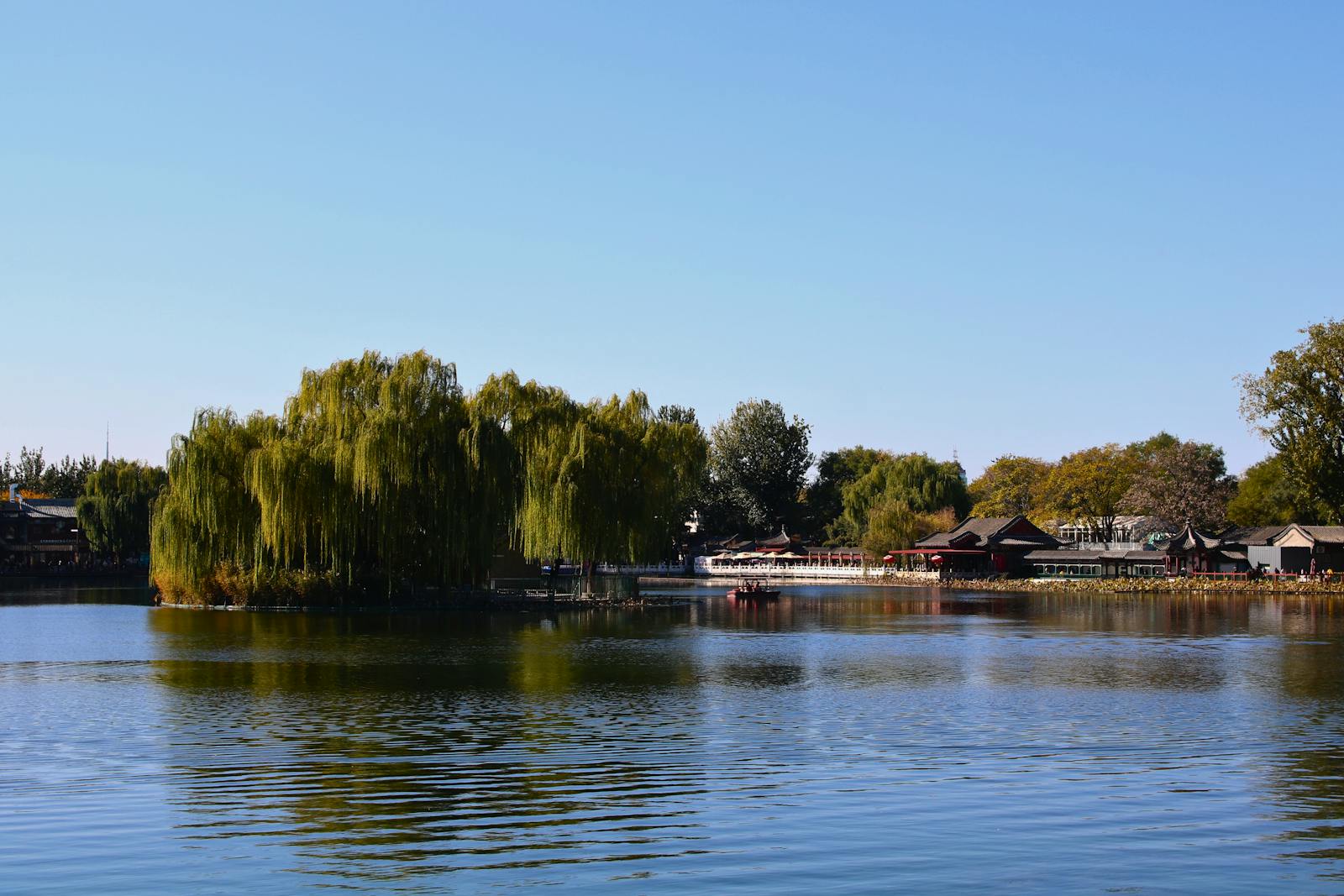
The southern and eastern banks of Houhai have, since the 1990s, been lined with bars. Yandai Xiejie (Tobacco Pouch Lane) — a 232-metre alley angling off the eastern shore — is the oldest concentration; the lakefront strip itself filled in through the early 2000s. Peak popularity was 2005–2015, when live cover bands played from open windows and the foreign-correspondent crowd settled here in summer. The clientele is now overwhelmingly domestic Chinese, the music quieter, and a few of the early venues are gone, but the strip is still active and still loud after dark.
Drinks run ¥40–80 for a beer in most lakefront bars, ¥60–120 for cocktails. There is no entry charge to walk the strip. Most venues open by 17:00 and close around 02:00. The crowd thickens between 19:30 and 22:30.
On the water itself, electric pleasure boats run from late spring through early autumn — typically late April to late October, weather depending. Rental booths sit at three points around Qianhai and Houhai. Self-drive paddle boats run about ¥40 per hour for a four-seater; piloted electric boats with a boatman, about ¥80 per hour. Last boats return at sunset.
Lotus, skating, walks
The lakes have a seasonal calendar that visitors used to short-stay travel often miss.
From mid-July to mid-August, lotus pads cover most of Houhai's surface, and the white and pink blooms open in the early morning and close by mid-afternoon. The best viewing is from the western bank, walking south to north, before 09:00. The lotus is not ornamental imported planting — it is descended from the agricultural lotus cultivated here under the Qing for seeds and root vegetables.
From late December through late February the lakes freeze. The municipal authority sets up an outdoor skating rink on the southern half of Qianhai, opening when ice depth reaches a certified minimum (typically late December). Entry is ¥30, skate rental about ¥30 more; ice chairs and ice bicycles for those who don't skate are about ¥40 per hour. The rink usually closes by 20:00, earlier on weekday evenings.
Spring (April) brings willow leaf-out around Qianhai. Autumn (October) brings yellow gingko along the western alleys. Both shoulder seasons have the smallest crowds and the longest windows of pleasant lakeside walking weather.
Getting there and around
Two subway stations serve the lakes. Line 8 stops at Shichahai, which sits closest to the northern end of Houhai and Yandai Xiejie. Line 6 stops at Beihai North, which is a 10-minute walk south to Qianhai through hutong alleyways — a more atmospheric arrival but slightly longer. Both routes are signed in English at street level. Beihai Park's north gate is also reachable from Beihai North station, making a combined Beihai-Houhai afternoon practical for visitors with limited time.
By foot, the entire lakefront perimeter — Qianhai, Houhai and Xihai together — runs about 5 km and takes 90 minutes at a walking pace. Bicycles are widely available through dockless rental apps; rates are ¥1.50 per 30 minutes, and the lakefront has dedicated cycle paths along most of the southern and eastern shores. Pedicabs (bicycle-rickshaws) work the lanes around the bar strip, but rates are negotiable and quoted prices are typically inflated for visible foreign visitors — settle the fare before getting in.