no. one · imperial
The Forbidden City: 980 buildings on 72 hectares
An imperial palace complex of 980 surviving buildings on 72 hectares, used by twenty-four emperors of the Ming and Qing dynasties from 1420 to 1912. Now the Palace Museum, holding the largest single collection of Chinese imperial artefacts in the world.
- District
- Dongcheng, central Beijing — bounded north by Jingshan Park, south by Tiananmen Square
- Built
- 1406–1420 by the Yongle Emperor, third Ming emperor; capital moved from Nanjing on completion
- Admission
- ¥40 winter (Nov–Mar) · ¥60 summer (Apr–Oct) · Treasure Gallery and Clock Gallery ¥10 each extra
- Hours
- 08:30–17:00 summer, 08:30–16:30 winter · last entry 16:10 · ticket office closes 60 min before
- Closed
- Mondays, except during national holiday weeks
- Access
- Subway Line 1 to Tian'anmen East, then walk north through Tiananmen Gate · entry only via Wumen (Meridian Gate)
Construction began in 1406 under the Yongle Emperor — third ruler of the Ming, who had taken the throne by force from his nephew and shifted the capital from Nanjing north to Beijing. A million labourers and 100,000 craftsmen worked the site for fourteen years. Completion came in 1420, and from that moment until the abdication of Puyi in February 1912, the palace was the residence and ceremonial centre of every reigning emperor of China — fourteen Ming, ten Qing, twenty-four in all.
What survives covers 72 hectares within a moat-and-wall rectangle 961 by 753 metres: 980 buildings and 8,886 rooms — a figure often confused with the popular myth of 9,999, a numerical conceit no Ming planner appears to have actually intended. UNESCO inscribed the site in 1987. Admission has been free of the old foreign-visitor surcharge since 2008.
Geography and the gates
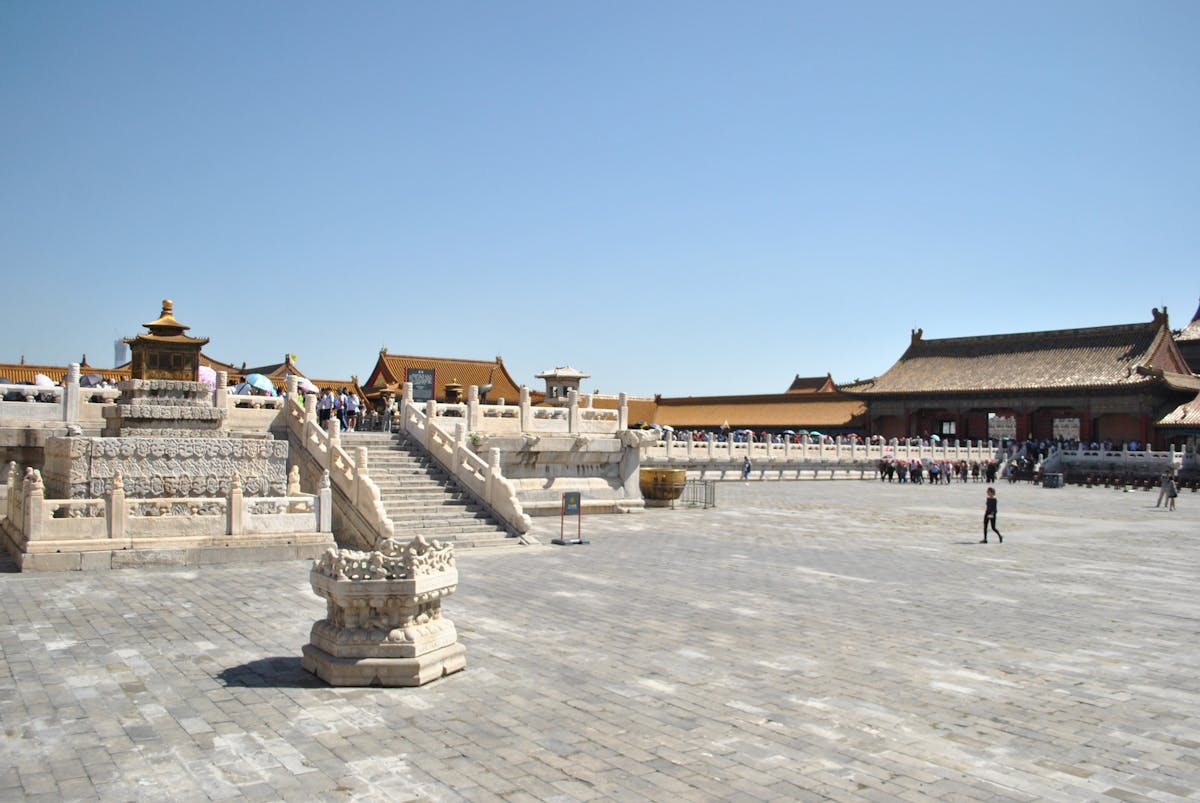
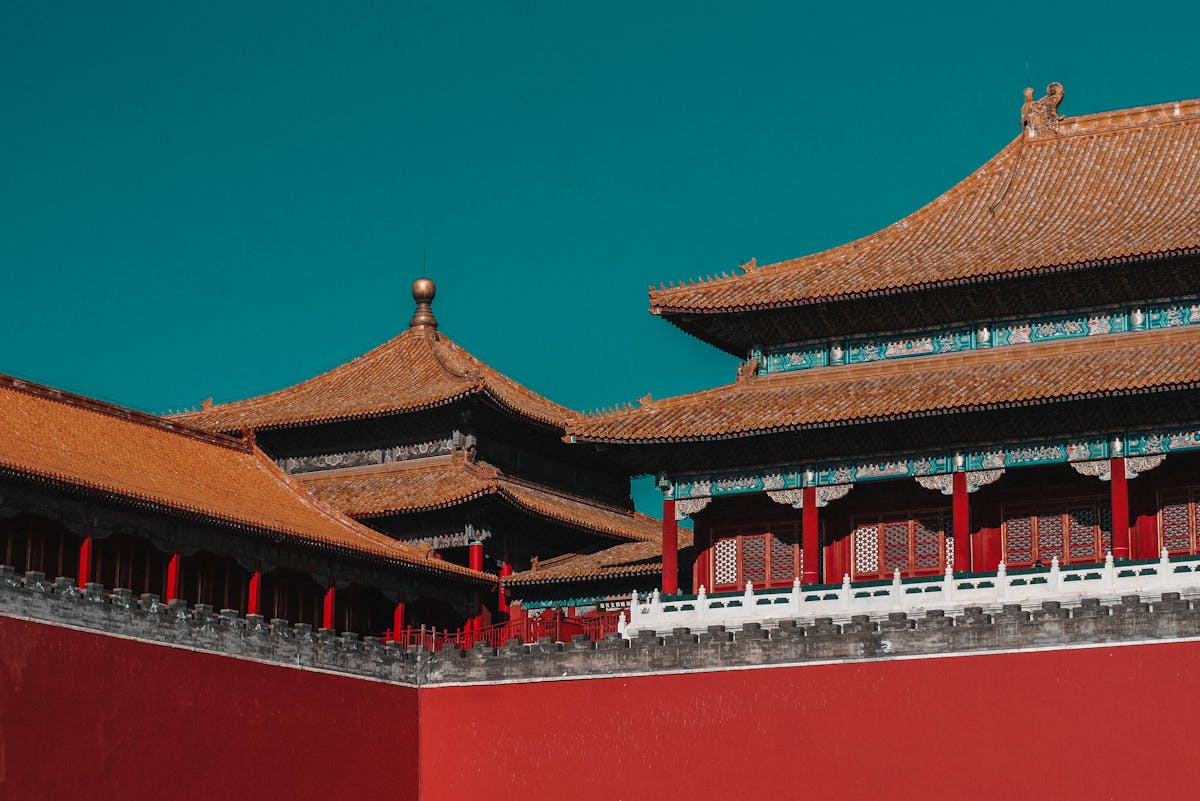
The palace sits on the central north–south axis of old Beijing, between Tiananmen Square to the south and Jingshan Park to the north. A 52-metre moat surrounds the perimeter; inside it, a 7.9-metre wall with a watchtower at each corner. Four gates pierce the wall — Wumen (Meridian Gate) south, Shenwumen (Gate of Divine Prowess) north, plus the East and West Glorious Gates on the side walls. Only Wumen functions as visitor entrance and only Shenwumen as visitor exit, which funnels foot traffic through the whole central axis from south to north — roughly 800 metres end to end.
Wumen, the largest of the four, was historically reserved for the emperor himself; senior officials used the side passages, lower officials the side gates. Today every visitor enters Wumen after passing through Tiananmen Gate (the rostrum on the square) and Duanmen behind it. Once a ticket is scanned, the walk to Shenwumen is one-way — no doubling back through the south gate.
The Outer Court
The southern half is the Outer Court — the state and ceremonial zone — built around three vast halls on the central axis. First and largest is the Hall of Supreme Harmony (Taihedian), used for coronations, imperial edicts, the New Year audience, the emperor's birthday, and announcement of successful candidates from the imperial examinations. It stands on a triple-tiered marble terrace; at 35.05 metres it is the tallest wooden structure in China. Inside sits the Dragon Throne, with carved screens and gilded columns flanking it.
Behind Taihedian stands Zhonghedian (Central Harmony), a smaller square pavilion where the emperor prepared himself before ceremonies and inspected seed grains for the spring sacrifice at the Temple of Heaven. Beyond it, Baohedian (Preserving Harmony) hosted New Year banquets and, after 1789, the palace examination — final stage of the civil service tests, judged by the emperor in person.
On the marble carriageway behind Baohedian
The single largest carved stone in the complex sits in the staircase ramp behind Baohedian — a 16.57-metre block of marble of around 250 tonnes, carved with nine dragons among clouds. It was hauled from a quarry roughly 70 kilometres south-west of Beijing along a road of poured ice in winter; records describe 28 days of haulage and more than twenty thousand men on the ropes.
The Inner Court
North of Baohedian, the Inner Golden Water Bridge separates the Outer Court from the Inner Court — the residential zone where the emperor and his household actually lived. Three smaller halls sit on the central axis here: Qianqinggong (Heavenly Purity), Jiaotaidian (Hall of Union), and Kunninggong (Earthly Tranquility).
Qianqinggong was the emperor's bedchamber under the Ming and early Qing; from the Yongzheng reign (1722–1735) the sleeping quarters shifted to the Hall of Mental Cultivation on the western side, and Qianqinggong became a state audience hall. Jiaotaidian housed the imperial seals — twenty-five of them, kept in carved wooden boxes around the walls. Kunninggong, the northernmost, was the empress's residence under the Ming and was repurposed by the Qing for shamanic rituals, with cooking pits installed for the daily sacrifice of pigs to the spirits of the Manchu homeland.
Flanking the central three are the Six Eastern and Six Western Palaces — twelve courtyard compounds where the imperial concubines and their attendants lived. Each is a self-contained walled court of around 0.5 hectares. Some are now hung with reproductions of period furniture; others host specialised exhibitions from the museum collection.
At the northernmost end, just before Shenwumen, sits the Imperial Garden — 12,000 square metres of pavilions, rockeries and ancient cypresses. It is the only significant green space inside the walls and the most crowded section by mid-afternoon.
Galleries within the museum
Since 1925, when Puyi was finally evicted from the Inner Court, the complex has functioned as the Palace Museum. It now holds roughly 1.86 million catalogued objects — the largest single collection of Chinese imperial artefacts anywhere. Most buildings are themselves the exhibits, walked through rather than entered; several side palaces and gate towers run as conventional curated galleries.
- Treasure Gallery — in the north-eastern Palace of Tranquil Longevity, retirement compound of the Qianlong Emperor; jade, gold, ceremonial weapons. ¥10 supplement.
- Clock Gallery — Fengxian Hall; eighteenth-century mechanical clocks gifted by European embassies. ¥10 supplement; live winding at 11:00 and 14:00.
- Ceramics Gallery — Wenhua Hall; chronological display from Tang through Qing.
- Painting and Calligraphy — rotating display in Wuying Hall; works exchanged every three months for conservation.
- Bronzes Gallery — eastern wing of Wuying Hall; ritual vessels from Shang and Zhou.
Booking and queues
Online booking has been mandatory since 2020, with no walk-up tickets sold at any gate. Tickets are released seven days in advance through the Palace Museum's official portal at en.dpm.org.cn; foreign passports are accepted, Chinese ID is not required. The same passport must be presented at Wumen on the day. Tickets sell out 1–7 days ahead in summer and on national holidays, and within hours on weekends.
Daily admission has been capped at 40,000 visitors since 2015. In practice the cap binds from late April through early October and around the Chinese New Year and National Day weeks; midwinter weekday slots are easier to obtain at one or two days' notice.
Time required
Walking the central axis from Wumen to Shenwumen without entering side courtyards takes a brisk visitor around 90 minutes, including a basic look at the six axial halls. Add two or three side courtyards, a pause in the Imperial Garden, and one or two supplement-ticket galleries, and the visit runs 3–4 hours. A comprehensive look — both wings of side palaces, all five major galleries, the corner watchtowers — takes 6–7 hours, more than most visitors will sustain in a day.
There is one exit and it does not loop back. Once a visitor passes through Shenwumen onto the north plaza, re-entry requires a new ticket on a new day.
Connections
Shenwumen opens directly onto Jingshan Front Street. Beihai Park is a ten-minute walk north-west; the entrance to Jingshan Park sits directly opposite Shenwumen, and its artificial hill — raised from moat soil in 1420 — gives the standard panoramic photograph of the palace roofscape. Tiananmen Square sits immediately south of the palace, separated from Wumen only by Tiananmen Gate and the smaller Duanmen between them.
For broader context on metro and taxi routing, see getting around Beijing. Inscription details sit on the UNESCO World Heritage register, with a concise historical overview at Britannica.